
Reviewed · LONDON WALKING TOURS
Southwark – an exclusive private walking tour full of surprises!
Southwark still feels like London with its sleeves rolled up. This private 3-hour walk around London Bridge’s doorstep mixes big landmarks (Borough Market, Southwark Cathedral, Shakespeare’s Globe) with the area’s people-first stories, from dockyard life to Tudor punishment. I especially loved how the tour pairs famous sights with clear, street-level explanations, and how Sandy keeps the pace friendly for questions. The only real drawback: it’s a walking tour—mostly outdoors—so if you hate even a few miles in rain, bring the right shoes and plan for stops.
You’ll also get a smart mix of “pretty” and “oh wow.” You’re standing by the Thames when the skyline tells its 900-year timeline, then you’re a few streets away from church ruins, a prison museum, and a graveyard uncovered during the Jubilee line work. I found it’s the kind of tour that helps you understand why Southwark has always been both convenient and controversial—because it was always in the middle of trade, power, and trouble.
In This Review
- Key things I’d highlight before you go
- Why Southwark feels like London’s “other side” of the story
- Meeting at London Bridge and what “private” really changes
- Hay’s Galleria: the quick Thames view that sets the tone
- Queens Walk: the skyline timeline from White Tower to modern City
- Borough Market: from wholesale chaos to today’s food buzz
- Southwark Cathedral: Henry VIII didn’t erase everything
- Golden Hinde: the ship replica that turns 1570s travel into a story
- Winchester Palace ruins: bishops’ power next door to everyday trouble
- The Clink Prison Museum: bishops, heretics, and buying comfort
- Shakespeare’s Globe: two theatres, one choice for your trip
- Tate Modern and Menier Chocolate Factory: old industry, new purpose
- Crossbones Graveyard: a forgotten burial ground found during the Jubilee line
- Price and what you’re really paying for at $219.31 per group
- Who should book this Southwark walk
- Should you book Southwark with Sandy
- FAQ
- Where does the tour start and end?
- What time does the tour run?
- How long is the Southwark tour?
- How far do you walk?
- Is it private, and how many people are in a group?
- Is there indoor time during the tour?
- Is food included?
- Are any attractions included with admission?
- What’s the cancellation window?
- Can you bring a service animal?
Key things I’d highlight before you go
- Small-group focus (up to 5): easy to hear, lots of chances to ask questions.
- Guide Sandy’s Southwark-only specialty: the stories stay on-target and detailed.
- Thames viewpoints that anchor the whole walk: Hay’s Galleria and Queen’s Walk set context fast.
- Cathedral interior time: Southwark Cathedral is the one indoor stop you’ll want to slow down for.
- Tudor contrasts in walking distance: bishops’ wealth, the Clink prison, and Crossbones Graveyard all connect.
- Paying attention to what you see outside: Tate Modern and Menier Chocolate Factory are quick but meaningful stops.
London on foot, a few more ways
- Magical London: Harry Potter Guided Walking Tour
★ 4.7 · 22,044 reviews - London: The Original Jack the Ripper Walking Tour
★ 4.7 · 7,833 reviews - Tour for Muggles The Ultimate Harry Potter Walking Tour in London
★ 5.0 · 4,684 reviews - London Jack The Ripper Guided Walking Tour
★ 5.0 · 3,131 reviews
Why Southwark feels like London’s “other side” of the story
Southwark is the borough that always seems to sit one step ahead of your expectations. On the map, it’s right there by the big sights. In real life, it plays like a separate London—older, rougher around the edges, and packed with the kind of history that happened because people lived, worked, worshipped, and got punished nearby.
What I like most is the contrast. You get the scenic edges of the Thames and the polished modern look of places built from old structures. Then, just a bit farther, you’re hearing about the long, complicated reputation Southwark earned—especially around power, rule-breaking, and the messy overlap between church influence and everyday life.
This tour is built to make those connections feel natural. Instead of treating each stop like a separate postcard, you’ll see the pattern: trade routes, religion, and authority, moving through the same streets over and over.
Meeting at London Bridge and what “private” really changes
You meet at London Bridge Station Approach Road (SE1 9SP) in the morning, and the tour ends near The Hop Exchange on Southwark Street (SE1 1TY). The start location is useful because it drops you right where Southwark’s story begins—right by the river crossing and the bustle of arrivals.
The private part matters. This isn’t a giant group shuffle. It’s kept small, up to five people, which means you can ask follow-ups without repeating yourself. Sandy also mentions comfort breaks are fine, which is underrated in London walking tours where people act like coffee doesn’t exist.
Plan for about 2–3 miles of walking over roughly 3 hours. Most of that is outdoors, and the tour goes ahead in rain or shine. The practical move is simple: wear good shoes and dress for weather. If it’s wet, waterproofs beat regret.
Hay’s Galleria: the quick Thames view that sets the tone
The first stop is Hay’s Galleria, a converted warehouse complex that now mixes shops, restaurants, offices, and apartments. It’s one of those spots where London shows you its “before and after” without needing a lecture.
What you’ll notice right away is the perspective. You’ll step toward Queens Walk at the back of the Galleria, and the views open out over the Thames toward the City of London. This matters because it gives you a mental anchor for later viewpoints—suddenly, you’re not just moving between attractions. You’re looking at the same river corridor through different centuries of change.
Admission is included for this stop, so you don’t have to scramble for tickets before you’re even settled.
Still deciding? A handful more London outings we rated
Queens Walk: the skyline timeline from White Tower to modern City
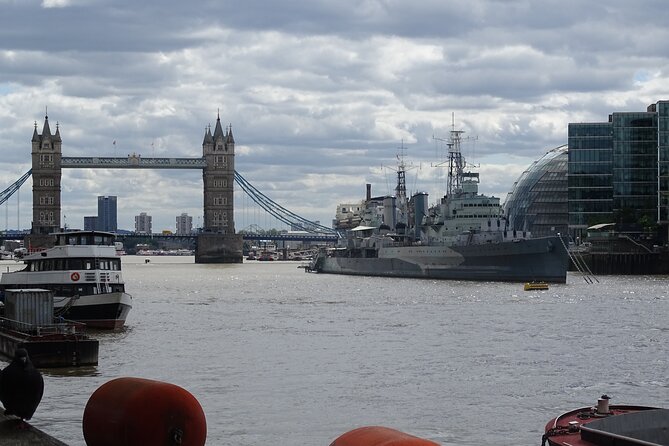
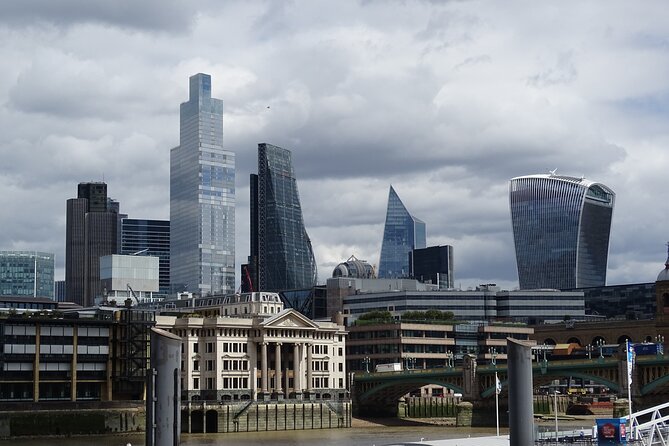
Queens Walk is the stretch that follows part of the riverside path between Tower Bridge and London Bridge. Sandy uses the scenery like a living timeline: you’ll compare major landmarks that represent very different eras and styles of power.
Here’s the key idea you’ll take away: the river tells stories of authority and commerce. On one side, the Tower of London area (including the White Tower) points back to Norman-era influence from the 12th century. On the other, you look at the City of London with buildings that feel like a totally different rhythm—modern, young by comparison, and built for today’s financial world.
You’ll walk just a short distance at this stop, but the impact is big. It’s also a great place to pause, check your bearings, and realize you’re not far from the Tower area—but you’re experiencing it from a Southwark angle.
Borough Market: from wholesale chaos to today’s food buzz
Borough Market sits at the heart of Southwark, and it’s a stop that works even if you’re not a serious foodie. Even from outside, it’s easy to understand why this place mattered: it used to be a wholesale trading hub for cattle, fish, and grain.
Sandy’s approach helps you picture how intense that trade would’ve been. The noise and activity you see today are real, but the meaning of the place is older. You’re watching commerce evolve—still urgent, still crowded in its own way, but now shaped for visitors as much as for buyers and sellers.
This stop is short, but it’s a smart reset. You get a street-level sense of what “market” meant here long before the craft stalls and casual lunches took over.
Southwark Cathedral: Henry VIII didn’t erase everything
Southwark Cathedral is the interior highlight on this walk, and it’s worth slowing down for. This is one of London’s oldest churches, and it survived the purge associated with Henry VIII—so you’re standing in a building that made it through one of the most disruptive eras in English religious history.
Designated a cathedral in 1905, the interior is a big reward after all the street history outside. You’ll see soaring arches and a dramatic ceiling that makes the space feel larger than you expect from the outside.
The stained glass is where Sandy’s storytelling really locks in. You’ll be pointed toward windows connected to Shakespeare, including a stained-glass dedication for the playwright who lived and worked in the Borough. You’ll also learn about a Diamond Jubilee window for Elizabeth II’s 60 years on the throne. There’s even a Harvard Chapel commissioned by Harvard alumni to honor John Harvard, who was baptized in St Saviour’s church when it was known as such.
If you like history with names attached—and you want your tour to feel human rather than just architectural—this is your stop.
Golden Hinde: the ship replica that turns 1570s travel into a story
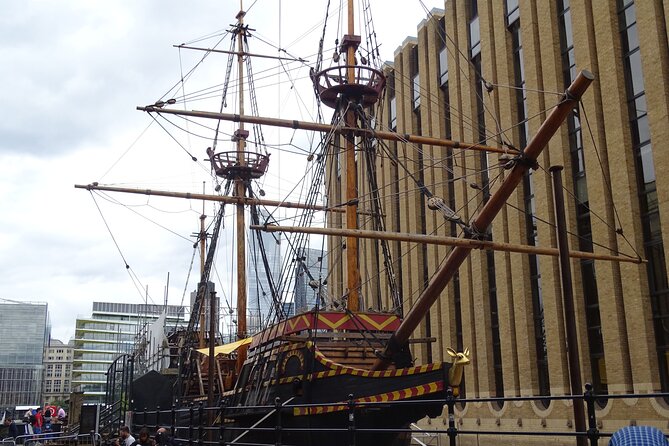
Next you’re near the river, beside a replica of the Golden Hinde, the ship known for circumnavigating the globe in the 1570s. Seeing a boat that size tied to such a hard voyage makes you stop thinking in modern comfort terms.
Sandy keeps this segment focused and fun. You’ll hear about what the ship was called originally, who was on board, and how many of the original fleet made it back to England. It’s only around five minutes, but the goal isn’t a museum visit. It’s to give you the right mental hooks so that later, if you see references to this ship, you understand why it mattered.
This is also a nice break from the heavier themes coming next—ships, travel, and navigation bring the story back out into the world.
Winchester Palace ruins: bishops’ power next door to everyday trouble
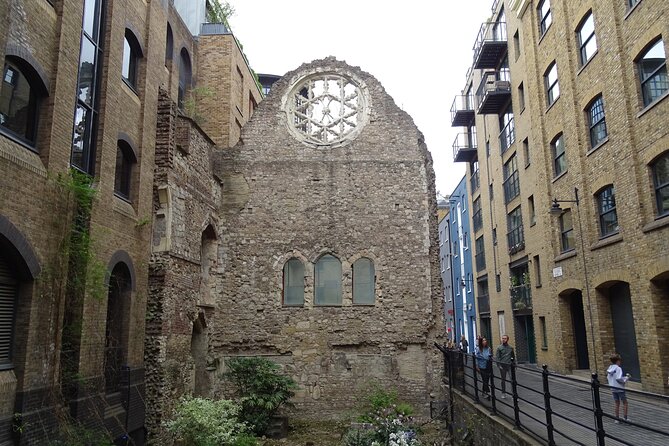
Winchester Palace is where you shift from the river and markets into the world of rules—literally. The ruins show the former large, luxurious home of the Bishops of Winchester.
The contrast is the point. Southwark includes narrow alleys and run-down yards today, but Sandy frames this as a long-standing pattern: privileged buildings and influence stood close to areas where ordinary people lived with far fewer protections. It’s a powerful reminder that power isn’t abstract. It has walls, boundaries, and an address.
Sandy also explains the meaning behind Winchester geese—an odd term that’s tied to the area’s past. Be ready for surprise here, because the tour doesn’t just name-drop. It connects the term back to what happened within the bishops’ lands.
This stop is short, but it changes how you interpret what you see on the map. You start noticing the “who had authority here” question behind the scenes.
The Clink Prison Museum: bishops, heretics, and buying comfort
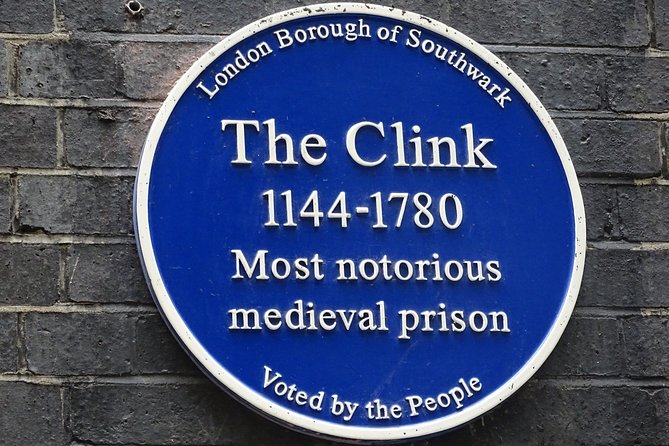
Right near Winchester’s ruins, you’ll reach the Clink Prison Museum. The museum stands on the site of the original Clink prison, which sat inside the bishops’ lands and next to their palace.
Sandy uses this to highlight a sharp contrast. The Clink’s function shifted over time. It went from imprisoning wrongdoers to housing heretics—people who held views that challenged the bishops’ authority.
You’ll hear about prison conditions and how you could buy your way into a more comfortable stay. That detail is unsettling, but it’s also historically important. The tour makes clear that punishment in that era wasn’t only about theology. It was also about control, access, and power.
Then Sandy ties it together by explaining how the Clink was eventually put to rest. You leave with a clearer sense of what this neighborhood was built to manage.
Shakespeare’s Globe: two theatres, one choice for your trip
Shakespeare’s Globe is where the tour leans back toward pop culture—without losing its historical spine. You’ll pass the location of the original Globe built toward the end of the 1500s, then within half a mile, you’ll see the modern Globe.
The story behind the modern theatre is the kind of detail that makes you care about what you’re looking at. Sandy points out that the modern Globe exists because of the perseverance of an American actor named Sam Wanamaker.
Here’s my practical advice: the tour gives you the outdoor look and the context. But if Shakespeare’s Globe matters to you, you should seriously consider booking an actual performance. Sandy’s point is simple—after you see the outside, you’ll probably want to step inside and experience the space as it was intended.
If you’re not planning a show, don’t worry. You’ll still get a stronger understanding of why the Globe location and timing mattered to London life.
Tate Modern and Menier Chocolate Factory: old industry, new purpose
From Shakespeare’s area, you’ll make quick stops that show how London repurposes buildings.
First is Tate Modern, which rises from what used to be a power station. Even if you don’t go inside, the shell of the building helps you imagine the scale of the original industrial purpose. Sandy also frames it as part of the Tate museums in England that focus on international art from the 1900s onward. Admission here is not included, and the stop is brief, so treat this as a context stop rather than an art-day plan.
Then comes the Menier Chocolate Factory. This historic building once housed a chocolate factory run by Meniers, and in the late 1800s the company was reportedly the largest chocolate manufacturer in France. The story turns in the 20th century when World Wars changed trade and recipe development, and neutral countries like Switzerland gained advantage in new formulations. The building fell into dereliction.
Instead of disappearing, it was designated a grade II listed building in the 1990s, meaning it couldn’t be demolished. That’s how it became a successful off-West End theatre. Sandy’s takeaway is that the building didn’t just get reused—it got repurposed in a way that kept the structure’s identity while giving it a new crowd and a new rhythm.
Crossbones Graveyard: a forgotten burial ground found during the Jubilee line
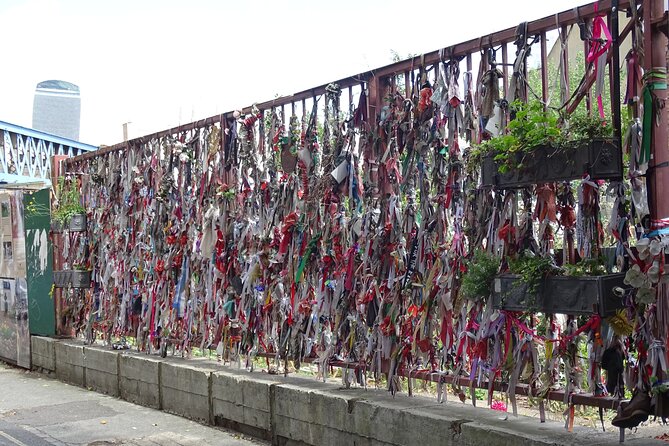
The last major stop is Crossbones Graveyard and the Garden of Remembrance. It’s one of those places where the ground itself tells the story, and Sandy explains how it was only discovered during Transport for London work on the Jubilee line extension.
Archaeologists from the Museum of London joined the excavations, and the estimate here is striking: around 15,000 bodies were buried on the site. This is where the tour brings the Winchester geese story back into view again, connecting the term to the people and the realities behind it.
It’s a short stop, but it hits hard because it grounds the earlier power-and-punishment themes in something literal: bodies, burial, and the long aftermath that outlives the reasons it started.
Price and what you’re really paying for at $219.31 per group
At about $219.31 per group (up to five people), you’re paying for privacy and focus, not just a list of sights. For this part of London, that’s a fair trade if you value a guide who can keep the story coherent across multiple stops and themes.
A bigger tour might get you “highlights.” This one aims for meaning. Sandy specializes in only five areas of London, and Southwark is one of them, which shows in how the explanations stay connected: Thames views become dockyard context; cathedral details become Tudor survival; bishops’ power becomes the logic behind the prison site and the nearby graveyard.
You also get practical value from included access where it matters. Hay’s Galleria admission is included, and most other listed stops don’t require you to pay on the spot (though Tate Modern is not included). The food isn’t included, so budget for your own snacks, but Sandy can still take a short break together if you want.
If you’re traveling as two to five people, the per-person value gets much better quickly. If you’re traveling solo, you might feel the price more than a family or group will.
Who should book this Southwark walk
This tour is a strong match if you want London history that’s not stuck in museum glass. You’ll like it if you enjoy story-driven walking—where the guide connects sites to social realities, including the harsh parts.
It’s also a good fit for:
- Small groups of friends or family who want to hear clearly and ask questions.
- People who want a mix of major landmarks and the less-famous details between them.
- Anyone interested in Shakespeare’s London, but also in the Tudor and pre-modern context around him.
If your idea of a London day is all slow museum time, you might find the pace a bit more physical than you’d like. Still, the stops are frequent enough that it doesn’t feel like one long slog.
Should you book Southwark with Sandy
I’d book it if you’re excited by contrast: views of the Thames and skyline, cathedral interiors, and then the darker side of bishops, prisons, and burial grounds—connected by the same streets. The small-group setup is a real advantage in a city where it’s easy to get swallowed by crowds.
Skip it only if you dislike outdoor walking, or if you’d rather do a stop-and-go checklist with no deeper explanations. For most people who want a smarter Southwark day with a guide who knows the area inside out, this is a solid use of time.
FAQ
Where does the tour start and end?
The tour starts at London Bridge Station Approach Road (SE1 9SP) and ends near The Hop Exchange, 24 Southwark Street (SE1 1TY).
What time does the tour run?
The start time is 10:00 am.
How long is the Southwark tour?
It lasts up to 3 hours.
How far do you walk?
You’ll cover about 2–3 miles in total.
Is it private, and how many people are in a group?
Yes, it’s private. Groups are kept small, up to five people.
Is there indoor time during the tour?
Yes. The tour is mostly outdoors, but it includes one internal stop to see the inside of Southwark Cathedral.
Is food included?
No. Food and drink are not included, though you can enjoy a break together with purchases at your own expense.
Are any attractions included with admission?
Hay’s Galleria admission is included. Other listed stops are marked as free where applicable, but Tate Modern admission is not included.
What’s the cancellation window?
Free cancellation is available up to 24 hours in advance for a full refund. Canceling less than 24 hours before the start time isn’t refundable.
Can you bring a service animal?
Yes, service animals are allowed.
More Tours in London
- From London: Harry Potter Warner Bros Studio Tour
★ 4.7 · 26,588 reviews - Magical London: Harry Potter Guided Walking Tour
★ 4.7 · 22,044 reviews - London: Warner Bros. Studio Harry Potter Tour & Branded Bus
★ 4.7 · 19,194 reviews - London Big Bus Hop-On Hop-Off Tour with Optional River Cruise
★ 3.5 · 10,803 reviews - London Small Group Tour of Historical Pubs
★ 5.0 · 10,422 reviews
More Tour Reviews in London
- From London: Harry Potter Warner Bros Studio Tour
★ 4.7 · 26,588 reviews - London: Westminster to Greenwich River Thames Cruise
★ 4.5 · 22,836 reviews - Magical London: Harry Potter Guided Walking Tour
★ 4.7 · 22,044 reviews - London: Madame Tussauds London
★ 4.6 · 20,915 reviews - London: Warner Bros. Studio Harry Potter Tour & Branded Bus
★ 4.7 · 19,194 reviews
More London Walks Worth the Shoe Leather
- Magical London: Harry Potter Guided Walking Tour
★ 4.7 · 22,044 reviews - London: The Original Jack the Ripper Walking Tour
★ 4.7 · 7,833 reviews - Tour for Muggles The Ultimate Harry Potter Walking Tour in London
★ 5.0 · 4,684 reviews - London Jack The Ripper Guided Walking Tour
★ 5.0 · 3,131 reviews - London: Harry Potter Movies Walking Tour (Kids Go Free)
★ 4.7 · 3,071 reviews
Just reviewed around London





London Walking Tours, compared.
 ★ 4.7Magical London: Harry Potter Guided Walking TourFrom $2022,044 reviews
 ★ 4.7The Original Jack the Ripper Walking TourFrom $257,833 reviews
 ★ 5.0Tour for Muggles The Ultimate Harry Potter Walking Tour in LondonFrom $234,684 reviews
 ★ 5.0London Jack The Ripper Guided Walking TourFrom $03,131 reviews
 ★ 4.7Harry Potter Movies Walking Tour (Kids Go Free)From $203,071 reviews
 ★ 5.0Changing of the Guard Guided Walking Tour in LondonFrom $251,793 reviews
 ★ 4.9The Great British Rock and Roll Music Walking TourFrom $361,783 reviews
 ★ 4.8Harry Potter Walking Tour in GermanFrom $201,505 reviews