
Reviewed · LONDON WALKING TOURS
Private Sightseeing Walking Tour of The City Of London
City of London packs a lot into a short walk. This private tour mixes Roman-era roots with major landmarks like St. Paul’s and the Tower area, plus stops that explain how London got rebuilt again and again.
I especially love the way the route balances photo-worthy sights with real context—16+ landmarks in about 3 hours keeps you moving without feeling rushed. One thing to plan for: you won’t go inside the Tower of London on this tour, and St. Paul’s Cathedral admission is not included.
In This Review
- Key moments at a glance
- Trinity Square: Port of London Authority, UN history, and the Merchant Navy memorial
- St Dunstan in the East to Leadenhall Market: ruins, Wren, and a Roman-forum location
- London Bridge and the Tower area: Roman crossing logic and big river views
- The Monument to the Great Fire: 1666 chaos, rebuilding lessons, and a nursery rhyme
- St Magnus the Martyr and London Stone: Wren rebuilds, a bridge replica, and a relic behind glass
- Oxford Court, Mansion House, and the Royal Exchange: power centers you can spot from the pavement
- Bank of England vaults, Ye Olde Watling, and City streets with film connections
- One New Change roof terrace: St Paul’s viewpoints and a ready-made group photo spot
- St Paul’s Cathedral finish: what you get in 20 minutes (and what you must pay for)
- Price and value: $171 per group for up to 15
- Who this tour suits best
- Should you book this Private City of London Walking Tour?
- FAQ
- How long is the Private Sightseeing Walking Tour of the City of London?
- What does the tour cost and how many people can be in a group?
- Where does the tour start and end?
- Is the Tower of London included inside the tour?
- Is St. Paul’s Cathedral admission included?
- Does the tour use a mobile ticket?
Key moments at a glance
- Trinity Square + UN inaugural reception and a strong stop on the Merchant Navy memorial
- St Dunstan in the East ruins with built-in “why London looks like it does” context
- Leadenhall Market near a Roman Forum site, plus Harry Potter film trivia
- The Great Fire Monument with conspiracy theories and a nursery rhyme connection
- One New Change roof terrace views over St. Paul’s, the Shard, Tate Modern, and the Thames
- St. Paul’s Cathedral finish (you’ll get time there, but admission isn’t included)
London on foot, a few more ways
- Magical London: Harry Potter Guided Walking Tour
★ 4.7 · 22,044 reviews - London: The Original Jack the Ripper Walking Tour
★ 4.7 · 7,833 reviews - Tour for Muggles The Ultimate Harry Potter Walking Tour in London
★ 5.0 · 4,684 reviews - London Jack The Ripper Guided Walking Tour
★ 5.0 · 3,131 reviews
Trinity Square: Port of London Authority, UN history, and the Merchant Navy memorial
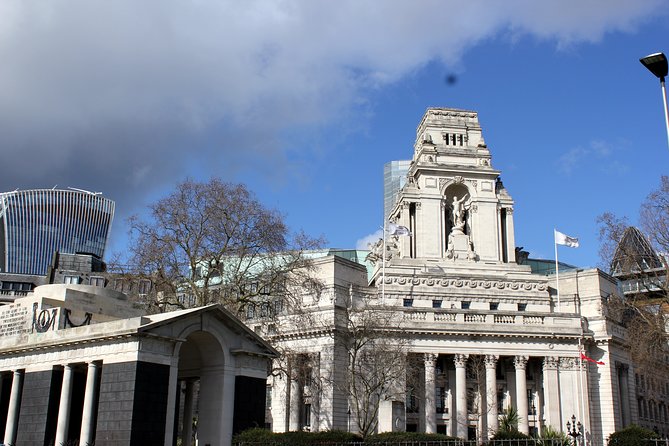
Your tour starts at 18 Fish St Hill near The Monument, then heads to Trinity Square, an area that makes the modern City feel tied to the sea. From here you can view 10 Trinity Square, once home to the Port of London Authority, when London was one of the world’s busiest ports. It’s a good opening because it instantly frames the City of London as a place built on trade and movement.
While you’re at Trinity Square, you’ll also spend time on the Merchant Navy memorial for heavy losses in both World Wars. Your guide uses that moment to talk about why merchant shipping mattered—not just during war, but as the supply line that keeps everyday life stocked with goods from abroad. If you like history that isn’t just kings and battles, this stop hits.
Tip for the best photos: look for angles where you can include the Thames-facing feel of the area. This part works well early in the walk because you’re still fresh and the lighting is often forgiving.
St Dunstan in the East to Leadenhall Market: ruins, Wren, and a Roman-forum location

From Trinity Square, the route moves into the City’s “survived and rebuilt” story. St Dunstan in the East is a public garden built around ruins that began as a 12th-century church, later with a tower added in the late 17th/early 18th century by Sir Christopher Wren. It’s one of those spots where you get both texture and meaning: fires, floods, and bombings all shaped how London rebuilt.
You’ll likely find great photo opportunities here, but the real value is the explanation—your guide ties the visible ruin to London’s repeated cycles of disaster and repair. That’s why this is more than a pretty stop; it’s a mental map of the city’s “layers.”
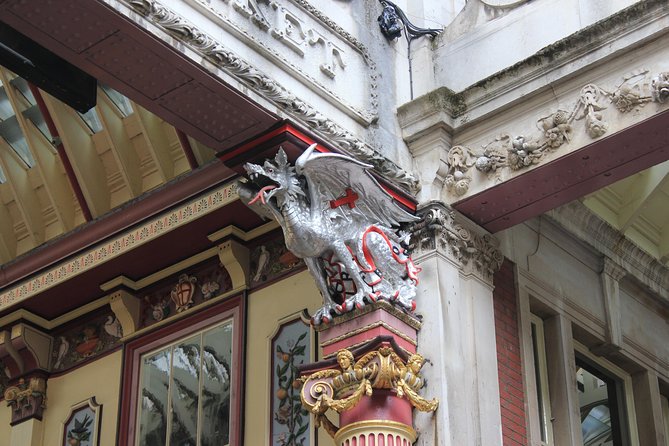
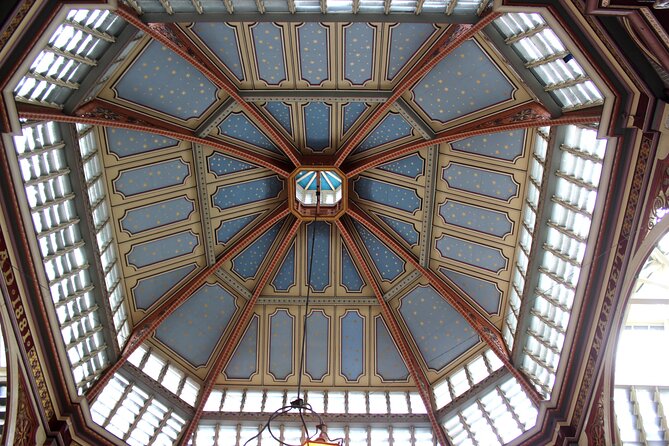
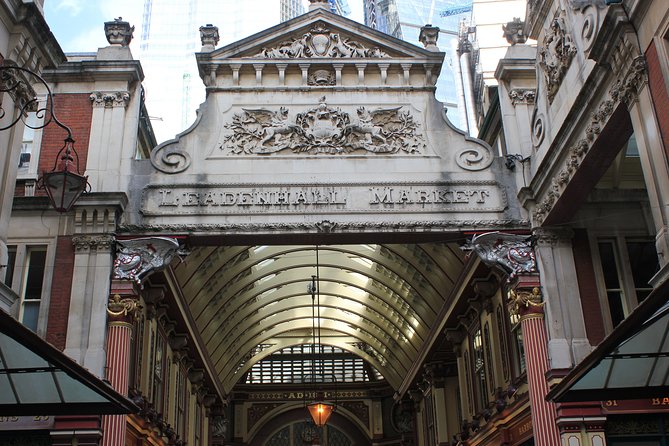
Next comes Leadenhall Market, named for the old lead roofed hall that once stood on the site, where the Roman forum was located. Today, it’s a neo-Gothic market with rich color tones—crimsons, greens, golds, and silvers—and it was designed by Sir Horace Jones. If you’re a Harry Potter fan, this is also the filming location for The Philosopher’s Stone, and your guide points out how it was used.
One small consideration: markets can get busy, so give yourself a little patience around the most popular photo angles. Your time here is short, but it’s long enough to see why locals love it.
London Bridge and the Tower area: Roman crossing logic and big river views
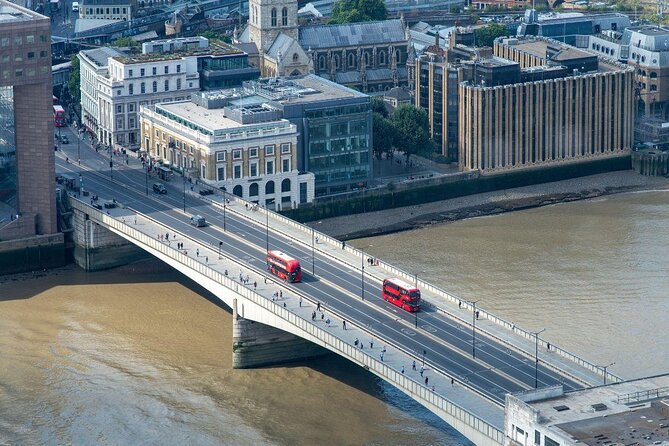
Then you hit London Bridge, which holds a lot of “London fact” energy packed into one place. It was, for centuries, the only bridge across the Thames, and the earlier structure helped the Romans invade. Your guide also shares the idea that the history of London Bridge has something to do with why Britain drives on the left—briefly, but memorably.
The big payoff is the view. From the area near Tower Bridge, you get panoramic sightlines toward the Thames, with the Tower of London and HMS Belfast visible. HMS Belfast is a former Royal Navy cruiser that saw action during D-Day landings and the Korean War, and your guide explains why it’s part of the UK’s Historic Fleet.
Now, here’s the practical expectation: you won’t enter the Tower of London on this tour. Outside the Tower, your guide still tells the Tower’s “why it mattered” story—royal palace, execution site, jail, and later the “high-security jewellery box” angle—plus connections to London Zoo, the Kray Twins, and how Rudolf Hess ended up imprisoned there during WWII.
If you want to tour the Tower interiors, you’ll need to add that separately. But as an orientation stop, this section does a lot of heavy lifting in a small time window.
Still deciding? A handful more London outings we rated
The Monument to the Great Fire: 1666 chaos, rebuilding lessons, and a nursery rhyme
A short walk brings you to The Monument to the Great Fire of London, built to commemorate the 1666 fire and the rebuilding that followed under Charles II. This stop is where your guide turns London’s biggest disaster into a story you can actually visualize.
You’ll talk through why the fire took hold and how the rebuilding was more complicated than most people expect. Your guide also covers conspiracy theories tied to the Great Fire, so it’s not just a straight timeline—it’s the “what people thought happened” layer too.
And yes, there’s a nursery rhyme connection, which is a fun way to anchor the information. It gives you something you can repeat later at dinner, which sounds silly until you realize it helps the history stick.
Practical note: this is a short stop. So if you’re hoping to go deep like a museum visit, keep your expectations realistic—but you’ll leave with a clearer sense of the city’s design and pace.
St Magnus the Martyr and London Stone: Wren rebuilds, a bridge replica, and a relic behind glass
Next you’ll see St. Magnus the Martyr, a striking church rebuilt after the Great Fire under the direction of master mason George Dowdeswell, supervised by Sir Christopher Wren. The church shows up in literature (including Dickens), so even if you’re not a deep church interior person, it’s an easy stop to connect to famous writing.
One highlight is the interior detail and the presence of a replica of the old London Bridge. That piece matters because the guide uses it to explain why the earlier bridge was so difficult to navigate. When you’ve seen the modern view and then look at that replica conceptually, the story lands fast.
After that, you’ll visit London Stone, often missed even by people walking right past it. It’s described as London’s oldest surviving treasure and was once at the heart of Roman Londinium, where proclamations and important events happened. It’s also associated (at least in older belief) with Arthur and Excalibur, and it’s been a tourist attraction for centuries—now kept behind glass.
This stop is short, but it’s excellent for two reasons: it teaches you where to look for “small but significant.” And it gives you a sense of continuity, showing how a single object became a landmark over time.
Oxford Court, Mansion House, and the Royal Exchange: power centers you can spot from the pavement
Between the major named sights, the tour adds one smart historical detour: Oxford Court, the site of St Swithin’s Church. The memorial there references the wife of Edmund Mortimer and her children, who were held there until she died in 1413. It’s a compact stop that expands the story from architecture and fires to the human stakes behind the city’s institutions.
Then you reach Mansion House, described as one of the finest Georgian palaces in London and home to the Lord Mayor of London. Your guide also mentions that it’s the place where the Chancellor of the Exchequer gives an annual Mansion House speech. The catch is straightforward: the interior is off-limits to the public, but you still get time to appreciate the exterior.
From there, you can view the Royal Exchange, opened by Elizabeth I. Your guide explains how it became one of the earliest stock exchanges and is sometimes framed as one of the oldest shopping malls still active today. In a short time, it helps you connect “finance” to physical place—not just abstract economics.
If you like walking tours that show you how to “read” neighborhoods, this section is a winner. You’re learning what each building represents without needing tickets or long lines.
Bank of England vaults, Ye Olde Watling, and City streets with film connections
At Bank of England, your guide covers the UK’s central bank and focuses on the vaults—there’s an emphasis on gold stored there. You’ll also hear about a story where a vault was broken into by accident, plus how vault locking uses both old and new technology. Then it ties back to what the Bank does in managing the economy.
It’s a quick stop, but the value is that it turns a “big institution” into specific details you can repeat. That makes it more memorable than just seeing a grand building and moving on.
Then there’s a more character-filled stop: Ye Olde Watling, a 17th-century pub built for builders working on nearby St. Paul’s Cathedral. It’s also linked to the idea of Sir Christopher Wren having a drawing-room there, and that Wren may have built the pub itself. Even if you take the legends with a grain of salt, it’s a fun example of how London’s creative workforce shaped its cityscape.
Finally, the route includes College of Arms, described as the oldest heraldic college in the world and founded by Richard III. Your guide explains genealogical research and the creation of new coats of arms, and you’ll also hear how this place connects to the James Bond film On Her Majesty’s Secret Service. The surrounding streets also connect to filming locations for James Bond, Doctor Who, Mission Impossible, and Harry Potter.
If you’re into film spotting, you’ll enjoy this blend. If you’re not, it still works because it’s about how the City’s look becomes part of popular culture.
One New Change roof terrace: St Paul’s viewpoints and a ready-made group photo spot
Before the finish, you’ll visit One New Change, a shopping mall in the heart of the City. This stop isn’t about shopping time; it’s about views. From the roof terrace (noted as free to access), you can see St. Paul’s Cathedral, plus other famous landmarks like The Shard, Tate Modern, The Globe, and the River Thames.
This is also where the tour becomes more relaxed. Your guide sets you up for a group photo, so you don’t have to scramble with awkward phone angles during the busiest part of the day. It’s a smart move because once you’re staring at St. Paul’s in person, you’ll want both “overview” and “final reveal” photos.
If the weather is rough, you might prefer to keep moving quickly here. Roof terraces can feel windy, and your time is limited—so treat this as a view-and-go moment.
St Paul’s Cathedral finish: what you get in 20 minutes (and what you must pay for)
The tour ends at St. Paul’s Cathedral, designed by Sir Christopher Wren. You’ll have about 20 minutes here, which is enough for a solid exterior look and some time to soak in the scale.
One key detail: St. Paul’s Cathedral admission isn’t included. So if you want to go inside (and see more than the outside), you’ll need to plan for that separately. This matters for your decision because 20 minutes can feel short if you’re hoping for full cathedral time.
That said, the tour’s overall strength is getting you oriented before you spend your personal time deeper. You leave with an understanding of Wren’s role, the post-fire rebuilding theme, and the way the City’s story feeds into this landmark.
This ending is also well-placed for continuing the day on your own. If you’re hungry, there are plenty of nearby places to grab lunch or a coffee right after the walk.
Price and value: $171 per group for up to 15
This tour costs $171.09 per group, up to 15 people, and it runs about 3 hours. That pricing can be an excellent value if you’re traveling as a small group that can fill part of the group capacity.
A quick way to think about value:
- If you’re the only couple, you’ll pay the group price split between just two people.
- If you have a larger group, the per-person cost drops fast because it’s priced per group, not per person.
What helps the value: many stops have free admission called out in the experience details, and the tour concentrates on landmarks you can otherwise spend extra time hunting for. The trade-off is you’re not paying for deep museum access everywhere. Only St. Paul’s admission is specifically called out as not included, so you’re budgeting a little extra if you want interior time.
Overall, it’s best value when you want an informed walking route and then your own follow-up time.
Who this tour suits best
This private walking tour is a strong fit if you:
- want a first-timer orientation to the City of London fast
- like a mix of Roman roots, the Great Fire, WWII connections, and Wren-era rebuilding
- prefer a guide who can tailor pacing and answer questions without being stuck in a big crowd
It’s less ideal if you:
- want Tower of London entry, not just the external context
- plan on spending a long time inside major interiors like St. Paul’s on the same visit
In the best-case scenario, this tour gives you the “map in your head,” and then you choose what to revisit.
Should you book this Private City of London Walking Tour?
I’d book it if your goal is to understand how the City became what you see today, without spending your whole day in lines. The route packs a lot of recognizable places—St. Paul’s, London Bridge, the Great Fire Monument—while still using smaller stops like London Stone and Oxford Court to make the history feel human, not just monumental.
I’d skip or consider adding on separate Tower and interior time if you’re the type who wants full-ticket experiences from start to finish. But if you like walking, photos, and stories you can carry with you, this is a solid way to get your bearings quickly and then explore the rest at your own pace.
FAQ
How long is the Private Sightseeing Walking Tour of the City of London?
It’s about 3 hours (approx.).
What does the tour cost and how many people can be in a group?
It’s $171.09 per group, with group size up to 15.
Where does the tour start and end?
The tour starts at 18 Fish St Hill, London EC3R 6DB and ends outside St. Paul’s Cathedral, at St. Paul’s Churchyard, City of London, London EC4M 8AD.
Is the Tower of London included inside the tour?
No. The tour notes that it does not have time to go into the Tower of London, though your guide explains its history from outside.
Is St. Paul’s Cathedral admission included?
No. The tour includes time at St. Paul’s Cathedral, but admission is not included.
Does the tour use a mobile ticket?
Yes. The experience lists a mobile ticket.
More Tours in London
- From London: Harry Potter Warner Bros Studio Tour
★ 4.7 · 26,588 reviews - Magical London: Harry Potter Guided Walking Tour
★ 4.7 · 22,044 reviews - London: Warner Bros. Studio Harry Potter Tour & Branded Bus
★ 4.7 · 19,194 reviews - London Big Bus Hop-On Hop-Off Tour with Optional River Cruise
★ 3.5 · 10,803 reviews - London Small Group Tour of Historical Pubs
★ 5.0 · 10,422 reviews
More Tour Reviews in London
- From London: Harry Potter Warner Bros Studio Tour
★ 4.7 · 26,588 reviews - London: Westminster to Greenwich River Thames Cruise
★ 4.5 · 22,836 reviews - Magical London: Harry Potter Guided Walking Tour
★ 4.7 · 22,044 reviews - London: Madame Tussauds London
★ 4.6 · 20,915 reviews - London: Warner Bros. Studio Harry Potter Tour & Branded Bus
★ 4.7 · 19,194 reviews
More London Walks Worth the Shoe Leather
- Magical London: Harry Potter Guided Walking Tour
★ 4.7 · 22,044 reviews - London: The Original Jack the Ripper Walking Tour
★ 4.7 · 7,833 reviews - Tour for Muggles The Ultimate Harry Potter Walking Tour in London
★ 5.0 · 4,684 reviews - London Jack The Ripper Guided Walking Tour
★ 5.0 · 3,131 reviews - London: Harry Potter Movies Walking Tour (Kids Go Free)
★ 4.7 · 3,071 reviews
Just reviewed around London





London Walking Tours, compared.
 ★ 4.7Magical London: Harry Potter Guided Walking TourFrom $2022,044 reviews
 ★ 4.7The Original Jack the Ripper Walking TourFrom $257,833 reviews
 ★ 5.0Tour for Muggles The Ultimate Harry Potter Walking Tour in LondonFrom $234,684 reviews
 ★ 5.0London Jack The Ripper Guided Walking TourFrom $03,131 reviews
 ★ 4.7Harry Potter Movies Walking Tour (Kids Go Free)From $203,071 reviews
 ★ 5.0Changing of the Guard Guided Walking Tour in LondonFrom $251,793 reviews
 ★ 4.9The Great British Rock and Roll Music Walking TourFrom $361,783 reviews
 ★ 4.8Harry Potter Walking Tour in GermanFrom $201,505 reviews