
Reviewed · LONDON WALKING TOURS
London: Churchill & World War 2 Walking Tour
Churchill’s London hits different on foot. This small-group WWII walking tour links power and wartime decisions to real streets and statues, with a professional guide in English. You’ll get a practical, start-to-finish feel for how Britain’s leadership worked under pressure while you also hear Churchill stories at key landmarks.
I love how the route mixes Churchill’s public image with the machinery of government—Downing Street, Parliament, the Treasury, and the Ministry of Defence. I also like that the walking time is tight enough to stay energetic, yet long enough to stop and think at major memorials like the Battle of Britain Memorial and the Cenotaph.
One thing to watch: Churchill War Rooms entry tickets are not included. You’ll see the War Rooms exterior, so if you want the underground exhibits, you’ll need to plan separate tickets.
If you want a focused WWII walk that feels grounded in London’s geography and not just in facts, this is a strong choice.
In This Review
- Key things that make this Churchill & WWII walk worth it
- Why this Churchill-focused walking tour is a smart use of time
- Starting at Embankment: where the walk sets its tone
- Downing Street and Parliament Square: Churchill’s public stage
- Churchill War Rooms: what you get outside, and what you must add
- The Battle of Britain Memorial: remembering through names and frieze
- Women of World War II Memorial and the Cenotaph: the story widens
- Ministry of Defence and HM Treasury: the practical side of wartime Britain
- St Margaret’s Church: Churchill’s personal tie to Parliament
- Price and value: what $19.01 gets you (and what it doesn’t)
- Who should book this Churchill & WWII walking tour
- Should you book this Churchill & WWII walk?
- FAQ
- Is Churchill War Rooms admission included?
- How long is the Churchill & World War 2 Walking Tour?
- Where does the tour start?
- Where does the tour end?
- What time does it start?
- What language is the tour offered in?
- What’s the group size limit?
- Is the tour suitable for mobility issues or strollers?
- Are service animals allowed?
- What is the cancellation policy?
Key things that make this Churchill & WWII walk worth it
- Churchill + government, side by side: you learn about the man and the institutions that helped run the war effort
- Major memorial stops: Battle of Britain, Women of World War II, and the Cenotaph keep the route emotionally honest
- Parliament Square sights in context: the Churchill statue connects directly to where wartime speeches happened
- Short, manageable time: about 2 to 3 hours with frequent stops so you’re never stuck “in transit”
- Small group size: capped at 25 travelers, which makes Q&A easier
London on foot, a few more ways
- Magical London: Harry Potter Guided Walking Tour
★ 4.7 · 22,044 reviews - London: The Original Jack the Ripper Walking Tour
★ 4.7 · 7,833 reviews - Tour for Muggles The Ultimate Harry Potter Walking Tour in London
★ 5.0 · 4,684 reviews - London Jack The Ripper Guided Walking Tour
★ 5.0 · 3,131 reviews
Why this Churchill-focused walking tour is a smart use of time
London has a lot of WWII content, but it can feel scattered. This walk keeps you on one theme: Churchill in the spotlight, and the government systems that tried to keep Britain functioning while bombs fell and air raids surged.
The pacing is built for real sightseeing. You’ll spend only around 5 to 10 minutes at each stop, which sounds quick until you realize it’s enough time to orient yourself, absorb context, and take in the details you’d miss if you just rushed through the area on your own. The tour also stays practical: you meet at Embankment station, then work your way toward Parliament and back around the Churchill War Rooms area.
You also get value from the guide-led format. A well-chosen guide turns familiar landmarks into a story you can follow. The theme here is straightforward: how Churchill lived inside the machinery of leadership, and what that leadership looked like in street-level London.
Starting at Embankment: where the walk sets its tone
You begin at Embankment station (Embankment Pl, London WC2N 6NS). That’s a good anchor point because it puts you near the core of central London without being too “tour bus” specific. You can usually connect to transit easily from multiple lines, and the meeting spot is close to public transport.
From the start, the tour’s theme becomes clear. You’re not just walking past famous buildings; you’re moving through a map of wartime decision-making and national symbolism. That’s the difference between reading about WWII and seeing how it’s embedded in London’s government district.
If you’re the type who likes to get bearings fast, this route helps. As you move toward Downing Street and Parliament Square, you begin to “see” the hierarchy: who sits where, who speaks from where, and what the city’s layout suggests about power.
Downing Street and Parliament Square: Churchill’s public stage
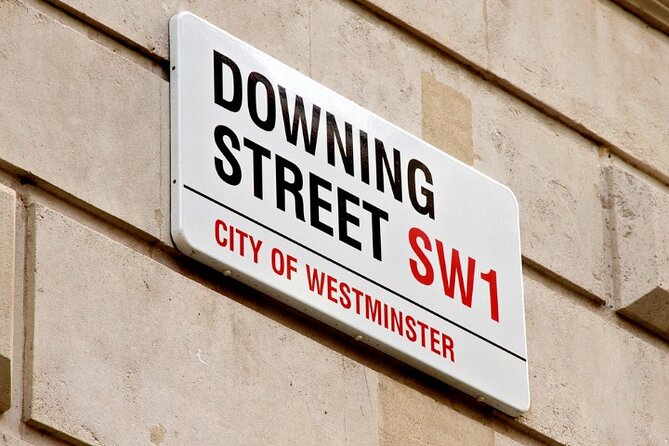
You’ll stop at 10 Downing Street, the famous home of the Prime Minister and, across the way, the Chancellor at No. 11. Even if you’ve seen photos, it hits differently when you’re standing there in daylight with a WWII story attached. The guide’s focus helps you understand why this address became such a symbol during wartime: leadership at the top, visible to the nation, and constantly under pressure.
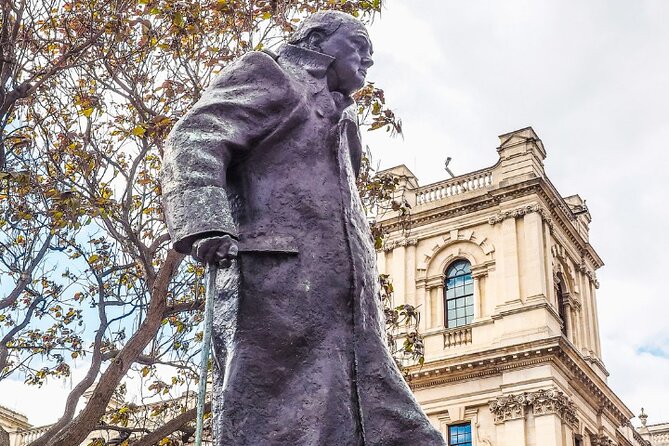
Next comes the Winston Churchill statue in Parliament Square. The bronze figure shows Churchill in an overcoat, leaning on his cane with a determined stance. It’s not just a portrait. It’s a message: Britain wanted Churchill’s resolve to be seen, and it wanted it close to the seat of political power.
Then you reach the Houses of Parliament. During WWII, it wasn’t a protected fantasy zone. It was targeted in air raids, including significant damage to the Commons chamber in 1941. Still, parliamentary sessions continued. That detail matters because it reframes the buildings you’re looking at. They’re not just architecture or a tourist backdrop—they’re proof the government kept working even when London was under threat.
If you want to photograph anything in a “WWII context,” this zone is where your camera will thank you. You can frame the statue and Parliament together and actually connect the symbols to the real political center they point to.
Still deciding? A handful more London outings we rated
Churchill War Rooms: what you get outside, and what you must add
The tour includes a stop at Churchill War Rooms, but with an important clarification: you only get the exterior. The underground complex is described as the nerve centre of British operations during World War II, built as a secret bunker to protect Churchill and his staff from bombings.
Here’s the practical consideration: because entry tickets are not included, you can’t count on this walk to replace a dedicated War Rooms visit. If you’re a Churchill fan or you really want the underground rooms and exhibits, consider booking those separately and treat this tour as the context-building “warm-up.”
That actually can be a good setup. After you’ve seen Downing Street, Parliament, and the surrounding memorials, the War Rooms stop feels like the last piece of a puzzle. But if you show up expecting to go downstairs without a plan, you’ll be disappointed—so plan ahead.
You end your tour in front of the Churchill War Rooms entrance area (tickets not included), so you’ll be in the right place if you decide to add the interior experience.
The Battle of Britain Memorial: remembering through names and frieze
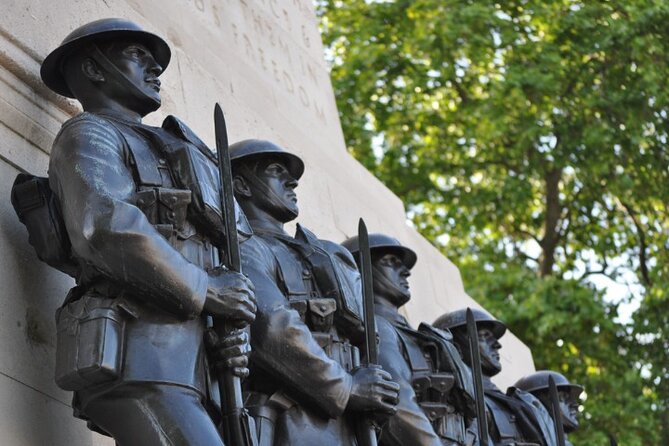
One of the emotional anchor points on this walk is the Battle of Britain Memorial. This bronze monument commemorates the Royal Air Force pilots who defended Britain during the pivotal air campaign of WWII.
What makes this stop more than a “pause for a photo” is the design. The monument includes a detailed frieze showing scenes from the battle, and it also features names of airmen who served. That combination—story scenes plus personal names—makes the memorial feel more grounded. It’s not abstract. It’s about people, and the guide’s commentary helps you connect the memorial to what it represents in Britain’s wartime survival.
If you want a moment to slow down, this is it. You’re standing at a national reminder of courage under extreme risk, and the walk gives you just enough time to absorb that without dragging your feet across the rest of the route.
Women of World War II Memorial and the Cenotaph: the story widens
This tour doesn’t leave the spotlight only on pilots and politicians. You also stop at the Women of World War II Memorial. It honours the contributions of British women during WWII, including civil defense, military services, and wartime industries. The memorial includes a bronze statue of a woman in overalls, representing women who worked essential roles. It’s a direct correction to the idea that home-front work was secondary.
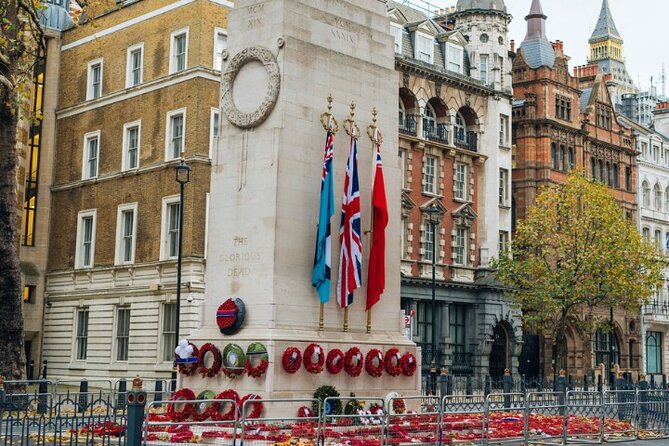
Then you reach the Cenotaph. This war memorial is dedicated to British and Commonwealth soldiers who died in both World Wars and later conflicts. The symbolism becomes especially clear because the annual Remembrance Day ceremony on November 11 honors fallen soldiers there. Even if you visit on an ordinary day, the Cenotaph communicates why remembrance matters: it’s the place where national grief and national memory meet.
If your ideal history tour includes real human stakes—not just dates and speeches—these two stops deliver. The tone shifts from power and survival to sacrifice and recognition, and the guide helps you hold both in your head as you keep walking.
Ministry of Defence and HM Treasury: the practical side of wartime Britain
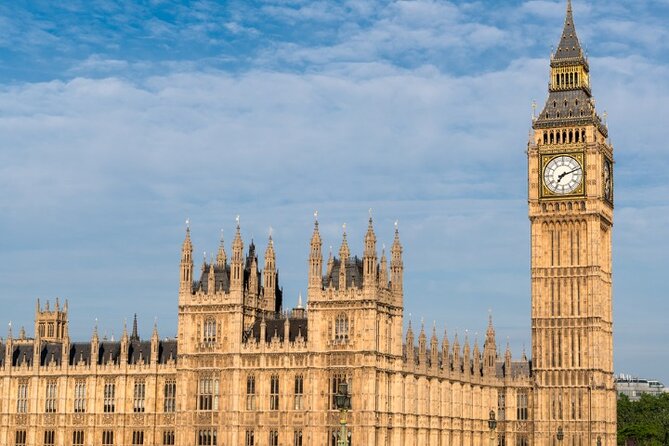
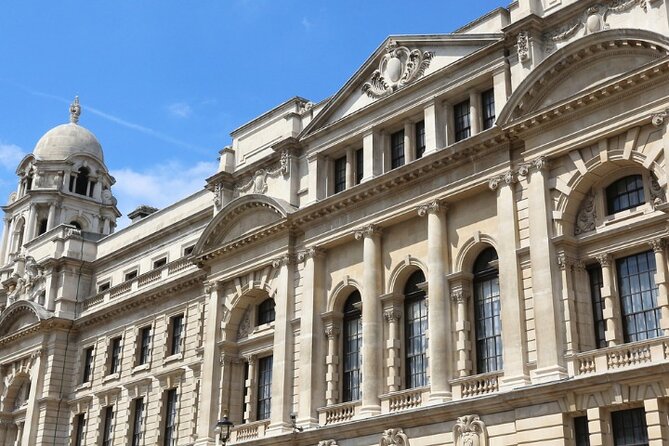
After the memorial moments, the walk turns back to institutions. You’ll stop at the Ministry of Defence (MOD), the government department responsible for national defence and military affairs. The headquarters is in the historic Main Building, and the stop helps you understand that wartime Britain wasn’t only battles and speeches—it was coordination, planning, and policy.
Next is HM Treasury. This is one of the stops that makes the tour feel unusually useful. The Treasury building played a pivotal role in WWII as a key site for Britain’s financial and wartime administration. It coordinated the war economy, making sure resources were managed for both military needs and civilian needs. There’s also a note about the basement serving as an emergency hub during air raids—another reminder that even the finance side had to survive the danger.
If you’ve ever wondered what it means when historians talk about “mobilizing a nation,” this is the part that makes it real. You’re looking at the places where systems ran, not just the places where headlines happened.
St Margaret’s Church: Churchill’s personal tie to Parliament
In the middle of the political landscape, you’ll visit St Margaret’s Church on Parliament Square. This church has a personal connection to Churchill: it’s the site of his 1908 wedding to Clementine Hozier. It’s also closely associated with parliamentary figures and is sometimes called the Church of the House of Commons.
The church dates back to the 12th century, which makes it a fascinating contrast to the WWII landmarks around it. You get a sense that the Churchill story isn’t only about 1940s crises. It’s also about long ties to British political life, and about the human anchors that sit near national institutions.
Even if you only spend around 10 minutes there, it’s long enough to notice the continuity in London’s story: old sacred spaces, modern political power, and then war-era urgency all in one area.
Price and value: what $19.01 gets you (and what it doesn’t)
At about $19.01 per person, this tour is priced for value if you want a guided walking route with major landmarks and a professional guide. The key “value lever” is that you get instruction and context across the whole area—Downing Street, Parliament, memorials, and government departments—without needing to pay entry fees at every stop.
But you do have one clear extra cost to consider: Churchill War Rooms admission is not included. The tour includes Churchill War Rooms exterior only. So think of this as a guided “Churchill and WWII London map” that ends right where you’d buy tickets if you want the full underground exhibit experience.
You’ll also want to factor in the time commitment. Expect about 2 to 3 hours. That’s just enough to cover a concentrated story without turning into a full-day plan.
One more practical note: the tour isn’t suitable for guests with walking or mobility difficulties, and it doesn’t work with prams or strollers. That doesn’t just affect comfort—it changes whether you can truly enjoy the stop-and-listen rhythm.
Who should book this Churchill & WWII walking tour
This is a great fit if you:
- Want a Churchill-focused route with government context, not only memorials
- Like guided walks where you stop often and listen
- Prefer smaller groups (max 25) with a professional guide in English
- Are interested in how WWII shows up in central London’s layout, monuments, and institutions
It’s also a good pick if you plan to visit Churchill War Rooms afterward. The exterior stop sets the stage so the underground experience (if you add it) feels less random.
You might skip it if you’re expecting museum-style entry to the underground complex as part of the tour price.
Should you book this Churchill & WWII walk?
Yes—if you want a focused, emotionally grounded tour of Churchill’s London that connects the man, the government district, and the memorials into one easy-to-follow storyline. The best part is the balance: political power stops sit next to remembrance stops, and the guide helps you see how both shaped wartime Britain.
Just don’t miss the big planning detail: War Rooms entry tickets aren’t included, and the tour only covers the exterior. If you want the underground exhibits, decide on tickets in advance and treat this walk as the context you’ll be thankful for once you go inside.
If you want to understand Churchill’s impact in a way that feels real—standing in the same spaces where symbols and decisions played out—this one is worth your time.
FAQ
Is Churchill War Rooms admission included?
No. The tour includes Churchill War Rooms exterior only, and entrance tickets are not included.
How long is the Churchill & World War 2 Walking Tour?
It’s about 2 to 3 hours.
Where does the tour start?
The tour starts at Embankment station, Embankment Pl, London WC2N 6NS, UK.
Where does the tour end?
The tour ends in front of Churchill War Rooms, King Charles St, London SW1A 2AQ, UK.
What time does it start?
The start time listed is 1:30 pm.
What language is the tour offered in?
The tour is offered in English.
What’s the group size limit?
The tour has a maximum of 25 travelers.
Is the tour suitable for mobility issues or strollers?
No. It’s not suitable for guests with walking or mobility difficulties, and it’s not suitable for prams, buggys, or strollers.
Are service animals allowed?
Yes, service animals are allowed.
What is the cancellation policy?
You can cancel for a full refund if you cancel up to 24 hours before the experience’s start time. If the minimum number of travelers isn’t met, you’ll be offered a different date/experience or a full refund.
More Tours in London
- From London: Harry Potter Warner Bros Studio Tour
★ 4.7 · 26,588 reviews - Magical London: Harry Potter Guided Walking Tour
★ 4.7 · 22,044 reviews - London: Warner Bros. Studio Harry Potter Tour & Branded Bus
★ 4.7 · 19,194 reviews - London Big Bus Hop-On Hop-Off Tour with Optional River Cruise
★ 3.5 · 10,803 reviews - London Small Group Tour of Historical Pubs
★ 5.0 · 10,422 reviews
More Tour Reviews in London
- From London: Harry Potter Warner Bros Studio Tour
★ 4.7 · 26,588 reviews - London: Westminster to Greenwich River Thames Cruise
★ 4.5 · 22,836 reviews - Magical London: Harry Potter Guided Walking Tour
★ 4.7 · 22,044 reviews - London: Madame Tussauds London
★ 4.6 · 20,915 reviews - London: Warner Bros. Studio Harry Potter Tour & Branded Bus
★ 4.7 · 19,194 reviews
More London Walks Worth the Shoe Leather
- Magical London: Harry Potter Guided Walking Tour
★ 4.7 · 22,044 reviews - London: The Original Jack the Ripper Walking Tour
★ 4.7 · 7,833 reviews - Tour for Muggles The Ultimate Harry Potter Walking Tour in London
★ 5.0 · 4,684 reviews - London Jack The Ripper Guided Walking Tour
★ 5.0 · 3,131 reviews - London: Harry Potter Movies Walking Tour (Kids Go Free)
★ 4.7 · 3,071 reviews
Just reviewed around London





London Walking Tours, compared.
 ★ 4.7Magical London: Harry Potter Guided Walking TourFrom $2022,044 reviews
 ★ 4.7The Original Jack the Ripper Walking TourFrom $257,833 reviews
 ★ 5.0Tour for Muggles The Ultimate Harry Potter Walking Tour in LondonFrom $234,684 reviews
 ★ 5.0London Jack The Ripper Guided Walking TourFrom $03,131 reviews
 ★ 4.7Harry Potter Movies Walking Tour (Kids Go Free)From $203,071 reviews
 ★ 5.0Changing of the Guard Guided Walking Tour in LondonFrom $251,793 reviews
 ★ 4.9The Great British Rock and Roll Music Walking TourFrom $361,783 reviews
 ★ 4.8Harry Potter Walking Tour in GermanFrom $201,505 reviews