
Reviewed · THAMES RIVER CRUISES
Run the Thames Bridges
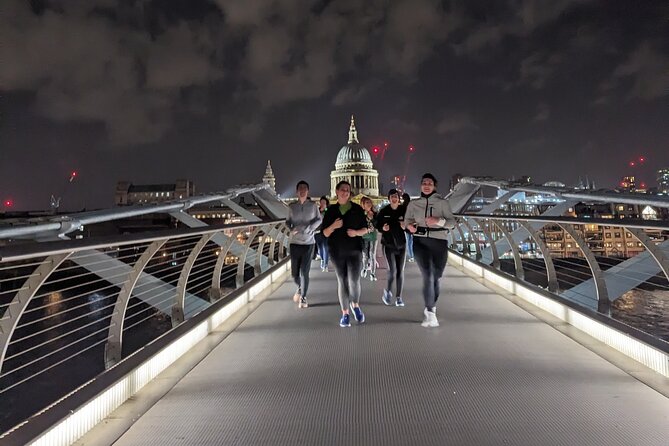
A Thames bridges run sounds simple, until the GPS starts talking. This self-guided experience maps out a 2- to 3-hour route with GPS-triggered audio so you move at your pace while big landmarks like Tower Bridge and London Bridge roll past. I like that it is set up for independent running: follow the cues, keep going, and you do not have to match anyone else’s stride.
What really makes it work is the combination of clear navigation and engaging narration. I like the way the audio is designed to keep you on track, including help if you drift off the route, so you can focus on the run instead of phone-checking. One drawback to plan around: it takes moderate physical fitness, and the total time includes travel time along the route.
In This Review
- Key things to love about Run the Thames Bridges
- Turning the Thames bridges into a runnable story
- Price and value: $23.31 for a self-paced Thames route
- Where you start near Tower Hill (and where you finish in Putney)
- How long it takes (and why the timing is honest)
- London Bridge stop: your first “big view” moment
- Tower Bridge and the Tower of London backdrop
- Shakespeare’s Globe and Westminster Bridge: the West End stretch
- Waterloo Bridge and the Southbank approach
- Battersea Power Station: modern London with a historic silhouette
- Battersea Park, Tate Modern, and Tate Britain: finishing with art views
- Navigation that doesn’t hijack your run
- Practical tips so you enjoy the run (and not just survive it)
- Who should book this Thames bridges run?
- Hours and practical availability
- Should you book Run the Thames Bridges?
- FAQ
- How long is Run the Thames Bridges?
- Where do I meet and where does it end?
- Is there an admission fee for the landmarks?
- Is it a group tour or self-guided?
- What language is the audio in?
- Can I cancel and get a refund?
Key things to love about Run the Thames Bridges
- GPS-triggered audio guides you step-by-step as you run, walk, or jog at your pace
- You get epic river-and-bridge views across the route, from London Bridge to Putney-area Thames sights
- Off-route GPS help means you can recover quickly if you take a wrong turn
- The running plan is flexible: you can split it across several days
- The tour is private, so it is just your group (no crowd pacing)
- Narration is set up in English, with route directions plus factual commentary
More time on the river, side by side
- London: Westminster to Greenwich River Thames Cruise
★ 4.5 · 22,836 reviews - London Big Bus Hop-On Hop-Off Tour with Optional River Cruise
★ 3.5 · 10,803 reviews - London: Westminster to Tower Bridge River Thames Cruise
★ 4.5 · 6,127 reviews - London: London Eye, River Cruise, & Hop-on Hop-off Bus Tour
★ 4.4 · 5,332 reviews
Turning the Thames bridges into a runnable story
This is not a sit-and-listen city tour. It’s a Thames walk/run that uses location-based audio to turn London’s biggest river crossings into something you can actually experience with your body. You’re moving through real neighborhoods, not just stopping at postcard points. That means you get the rhythm of the river: short bursts of effort, open views, then a new stretch with fresh angles on the skyline.
The format is simple. You follow the GPS prompts, the audio cues trigger when you reach specific places, and the whole thing is paced so you do not feel rushed. If you have run in big cities before, you know the problem: you pick up wrong turns, second-guess directions, and lose time. This route aims to prevent that by keeping the guidance tied to where you are.
Price and value: $23.31 for a self-paced Thames route
At $23.31 per person, you are paying for a guided experience without paying for a traditional group tour. That matters in London, where the cost of organized tours can add up fast. Here, your main “ticket” is the GPS audio guidance that tells you what you’re seeing and where to go next.
Also, most of the landmarks on the route are part of the public streets and river viewpoints—so you’re not buying a stack of separate admission tickets just to get the experience. The route includes several major sites (bridges, the Thames viewpoints, and high-profile buildings) with admission ticket free noted for the stops. That makes the price easier to justify: you’re paying for time-saving navigation and a structured route, not for a museum ticket.
Where you start near Tower Hill (and where you finish in Putney)
The run starts at the Sundial at Tower Hill, London EC3N 2LY, UK. The end point is outside Putney Station on Putney High Street, London SW15 1RT, UK.
Why the exact endpoints matter: a river route is only fun if you can drop into it and exit cleanly. Starting near Tower Hill puts you in reach of the East/Central river stretch, and finishing in the Putney area gives you an easy off-ramp into local transport. The tour is also labeled as near public transportation, which helps if you are combining it with sightseeing later.
Another small but helpful detail: the run is private. So if you’re traveling with friends, you are not forced into a single pace or a single group dynamic. You can plan your run times without worrying about being “late” for someone else.



How long it takes (and why the timing is honest)
Expect 2 to 3 hours (approx.). The experience notes that travel time is added to the total duration. Translation: this isn’t just nonstop running time, and it is not a vague estimate. You’re moving between the landmark zones, and the schedule reflects that.
You can also split it over several days if you need to. That’s a big deal if you are traveling and your schedule is messy. A two-hour run in a new city can still be tough when you’re jet-lagged, navigating other plans, or tired from walking. Being able to stretch the route across multiple days helps you keep it fun instead of turning it into a chore.
London Bridge stop: your first “big view” moment
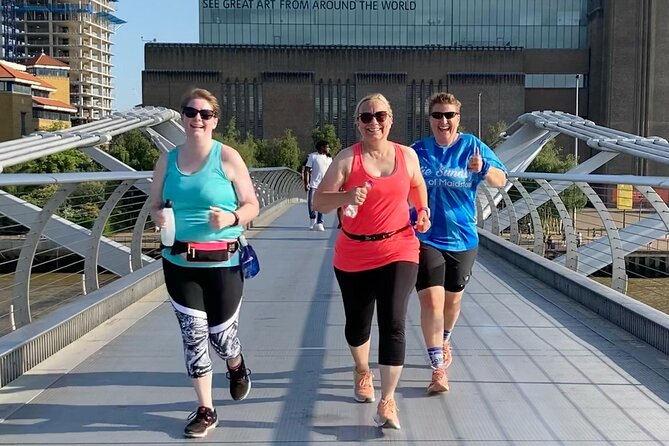
One of the early anchors is London Bridge. The stop is listed at about 30 minutes, with admission ticket free.
This is where the run turns from a route into a sightseeing experience. London Bridge isn’t just a crossing; it’s a point where you can orient yourself to the Thames corridor. As you run over it, the audio is there to frame what you’re passing and why it matters in the surrounding area.
A practical tip: London Bridge can feel exposed because it’s a classic Thames crossing with wide sightlines. If you’re running on a warm day, expect that some segments of the route will be more open to sun and wind than others. The good news is that moving bridge to bridge usually gives you new angles and breaks in the exposure.
Tower Bridge and the Tower of London backdrop
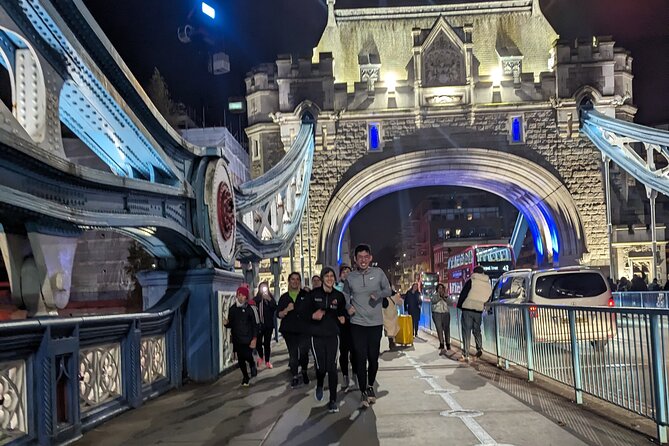
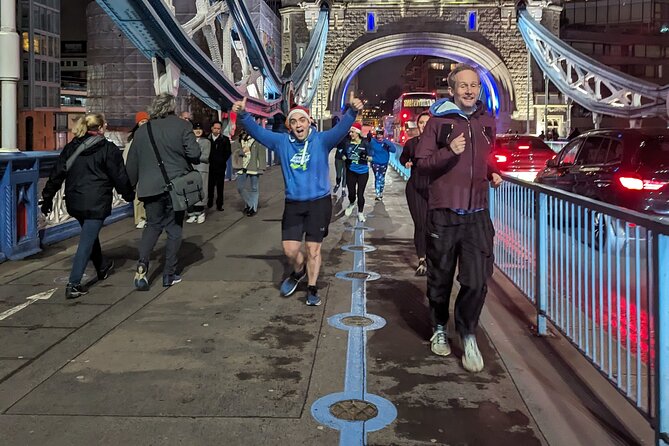
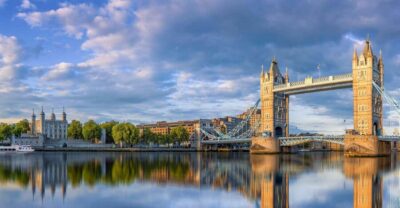
The experience also centers Tower Bridge (listed at 20 minutes, admission ticket free). The route guidance emphasizes that the run begins in the Tower Bridge area, and you’ll get big views of the bridge itself plus the Tower of London in the mix.
Tower Bridge is one of those places where distance and angle change everything. Running through or alongside the river viewpoints lets you see details you’d miss standing still. And because the audio cues are GPS-triggered, you’re not left guessing when you’re at the “right” spot for the next story beat.
If you worry about getting lost on a river route, this is one of the strongest reasons to choose GPS guidance. The guidance is built to keep you aligned so you reach the intended viewpoints, not just any random segment of the Thames.
Shakespeare’s Globe and Westminster Bridge: the West End stretch
After the bridges, you transition into a more built-up, headline-friendly section of the river. Your route includes several “pass-by” zones:
- You run past Shakespeare’s Globe theatre with about 10 minutes travel time
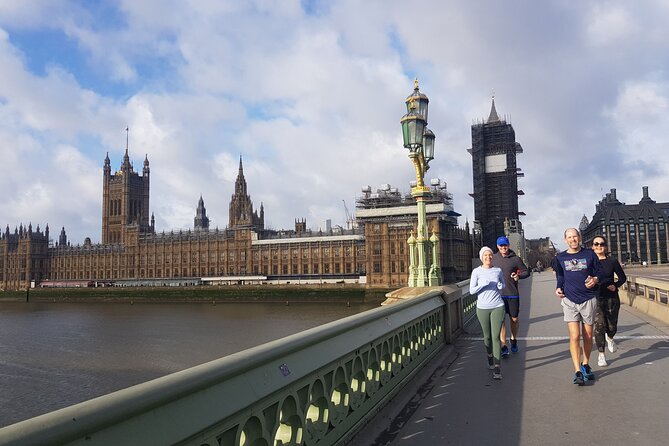
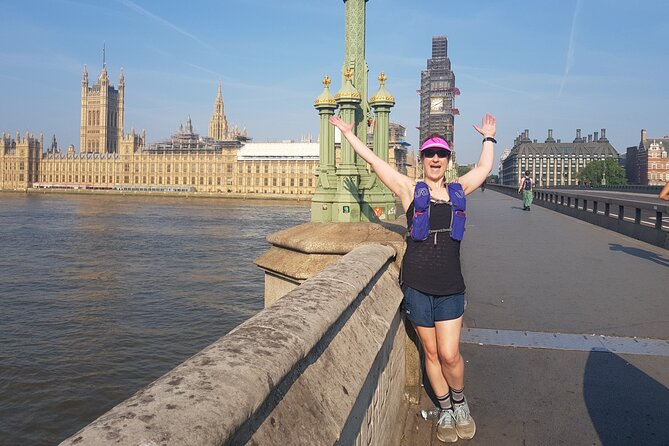
- You cross by Big Ben on Westminster Bridge with about 20 minutes travel time
- You get full visibility of the Houses of Parliament as you run across the South Bank, about 20 minutes travel time
This is the part of London where the landmarks feel like they’re watching you. The trick is not just seeing them—it’s understanding the context while you’re moving. The GPS-triggered audio is designed to attach commentary to the moment you’re at the river crossing, so it feels connected rather than like random trivia on the move.
One more practical point: Westminster and the South Bank can be busy on foot. Running a route like this works best if you treat it like a steady progress mission. Keep your pace comfortable, and let the guided audio do the “what’s next” work.
Waterloo Bridge and the Southbank approach
The next major bridge stop is Waterloo Bridge (about 30 minutes, admission ticket free). You then run through the nearby Southbank area.
Waterloo is a strong “middle-to-late route” point because it keeps you in London’s thick of activity while still giving you that river-facing running feel. It’s also a useful mental reset: you’ve already passed some major landmarks, and now you settle into the long stretch where you can focus on form, breathing, and staying relaxed as the route carries you forward.
In hot weather, this area often helps because you can shift your position along the river and find small breaks in exposure between bridges. If you tend to overheat quickly, this is the part where staying patient pays off.
Battersea Power Station: modern London with a historic silhouette
Next up is Battersea Power Station (about 20 minutes, admission ticket free). The route is set up to explore the new development area as you run past it.
This stop is different from the earlier “old-world monument” vibe. It’s a London contrast moment: you get a legendary industrial silhouette while also seeing the newer energy of redevelopment. That balance is exactly what makes a bridge run more interesting than a single-bridge checklist.
Because the narration is GPS-driven, you’re less likely to miss the interpretive cues. Instead of rushing past because you’re focused on distance, you get prompted to notice what changed, what stayed, and how the river corridor ties it all together.
Battersea Park, Tate Modern, and Tate Britain: finishing with art views
The route continues to Battersea Park (about 20 minutes). You’ll have park visibility from across the Thames as you run along the North bank.
After that, the route passes:
- Tate Modern (about 5 minutes travel time)
- Tate Britain (about 5 minutes travel time)
Even if you’re not stepping into the museums, these are smart “finish-zone” landmarks. They make the Thames feel like an open-air gallery route, and they give you that satisfying end-of-run feeling: you’ve covered the bridges, hit the headline areas, and now you’re closing near cultural anchors.
This also helps with pacing. A route with several different “types” of sights—bridges, political landmarks, redevelopment, parks, and art institutions—keeps the run interesting even when your legs start to complain.
Navigation that doesn’t hijack your run
A standout feature is how the guidance behaves if something goes wrong. If you go off-route, your GPS will guide you back. That takes away the usual stress of self-guided running in a dense city.
It also helps that the audio prompts are described as being very clear and well timed, triggered by GPS. The goal here is that you do not have to hesitate or repeatedly check your phone. For many runners, that’s the difference between a fun route and a frustrating one.
One more detail worth knowing: the narration is set up as a route guide voice plus a separate factual info voice. That separation makes the experience easier to follow on the move—you get the directions without losing the meaning of what you’re seeing.
Practical tips so you enjoy the run (and not just survive it)
- Wear running shoes you trust. You’re spending a few hours moving through mixed surfaces and paths near major river crossings.
- Charge your phone and plan for headphones. Since it’s a GPS-triggered audio tour, you’ll want your audio setup ready.
- Pick a comfortable pace. The experience is designed for your schedule, and it’s better to finish strong than to force it.
- If it’s hot, expect exposure on some bridge stretches. The route alternates between open views and calmer segments, but the big crossings can feel punishing when the sun is out.
- If you need to split it across days, use that flexibility. It keeps the route manageable and reduces the pressure to do everything in one session.
Who should book this Thames bridges run?
This is best for you if you want a structured river route with narration, but you do not want to manage a group, a pace line, or a complicated itinerary. It’s also ideal if you like the idea of choosing your day within the operation window.
You’ll feel most comfortable if you have at least moderate physical fitness. It’s a run, not a gentle stroll, and it includes multiple river crossings and extended movement between landmark zones.
It’s also a good fit for:
- solo travelers who want guidance without constant interaction
- small groups who prefer private pacing
- people who like history and city context but want it delivered while moving
Hours and practical availability
The listed operating window is 5:00 AM to 10:00 PM, Monday through Sunday, from 05/13/2024 to 11/26/2026. That flexibility helps you choose a start time that matches your energy, and it makes it easier to fit into a sightseeing day.
Should you book Run the Thames Bridges?
Book it if you want a self-paced, GPS-guided way to string together London’s biggest Thames crossings into a single, doable run. The price is reasonable for what you’re getting: structured navigation, timed audio prompts, and landmark context across a route that hits London Bridge, Tower Bridge, Westminster, Waterloo, Battersea, and the Tate areas.
Skip it (or plan carefully) if you’re not comfortable with a couple of hours of sustained movement, because the route is built for runners and people with at least moderate fitness. And because the guidance is tied to your device, make sure your phone and audio setup are ready before you start.
If you like tours where you keep moving and learn along the way, this one is a solid match.
FAQ
How long is Run the Thames Bridges?
It’s listed as about 2 to 3 hours, and the duration includes travel time added to the total.
Where do I meet and where does it end?
You start at Sundial at the Tower Hill, London EC3N 2LY, UK, and you end immediately outside Putney Station on Putney High Street, London SW15 1RT, UK.
Is there an admission fee for the landmarks?
The stops are marked with admission ticket free, so you’re not paying separate entry fees for the listed landmark moments.
Is it a group tour or self-guided?
It’s a private activity for your group, and the experience is designed as a GPS-triggered audio tour that follows you at your pace. If you go off-route, your GPS will guide you back.
What language is the audio in?
The audio tour is offered in English.
Can I cancel and get a refund?
No. This experience is non-refundable and cannot be changed for any reason.
More Tour Reviews in London
- From London: Harry Potter Warner Bros Studio Tour
★ 4.7 · 26,588 reviews - London: Westminster to Greenwich River Thames Cruise
★ 4.5 · 22,836 reviews - Magical London: Harry Potter Guided Walking Tour
★ 4.7 · 22,044 reviews - London: Madame Tussauds London
★ 4.6 · 20,915 reviews - London: Warner Bros. Studio Harry Potter Tour & Branded Bus
★ 4.7 · 19,194 reviews
More Time on the Thames
- London: Westminster to Greenwich River Thames Cruise
★ 4.5 · 22,836 reviews - London Big Bus Hop-On Hop-Off Tour with Optional River Cruise
★ 3.5 · 10,803 reviews - London: Tootbus Hop-on Hop-off (Optional River Cruise)
★ 3.9 · 7,045 reviews - London: Westminster to Tower Bridge River Thames Cruise
★ 4.5 · 6,127 reviews - London: London Eye, River Cruise, & Hop-on Hop-off Bus Tour
★ 4.4 · 5,332 reviews
Just reviewed around London





Thames River Cruises, compared.
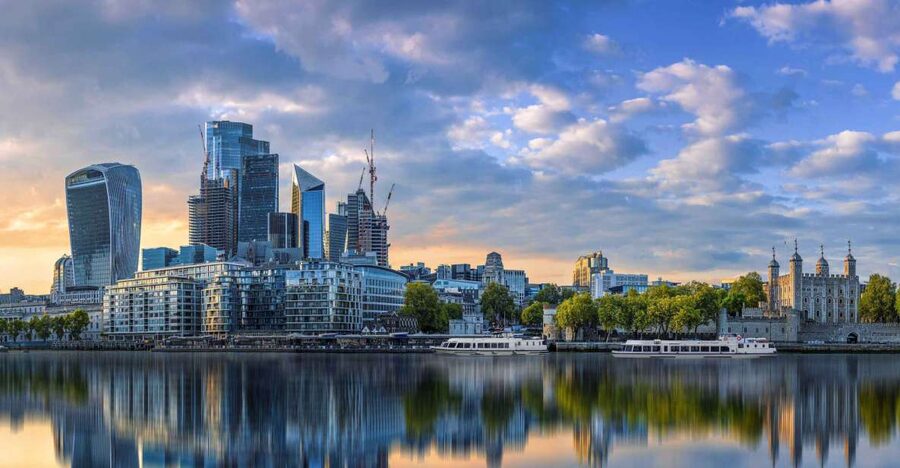 ★ 4.5Westminster to Greenwich River Thames CruiseFrom $2222,836 reviews
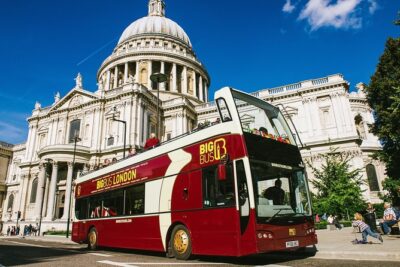 ★ 3.5London Big Bus Hop-On Hop-Off Tour with Optional River CruiseFrom $3910,803 reviews
 ★ 3.9Tootbus Hop-on Hop-off (Optional River Cruise)From $477,045 reviews
 ★ 4.5Westminster to Tower Bridge River Thames CruiseFrom $186,127 reviews
 ★ 4.4London Eye, River Cruise, & Hop-on Hop-off Bus TourFrom $745,332 reviews
 ★ 5.0High-Speed Thames River Speedboat in LondonFrom $903,971 reviews
 ★ 4.5Thames River Cruise with Optional London Eye TicketFrom $203,900 reviews
 ★ 4.1Big Bus Hop-on, Hop-off with Optional River CruiseFrom $353,875 reviews
Browse the lists this tour appears in