
Reviewed · BRITISH MUSEUM TOURS
London: British Museum Guided Tour
One stone unlocked centuries of writing. This British Museum guided tour is a smart, time-saving way to see the museum’s headline objects, with stop-by-stop context from the Rosetta Stone to major sculptures. It’s built for people who want a clear path through a very big building, without turning the visit into a scavenger hunt.
I especially like how the route balances the famous with the unexpected. You’ll get major hits like the Benin Bronzes and Parthenon sculptures, but also curveballs such as a moai statue (the Hoa Monument) and the Tree of Life made from decommissioned weapons. One drawback to keep in mind: depending on the guide and group, the pace and clarity can vary, and at least one guest found the accent harder to follow and wanted fewer side stories.
In This Review
- Key highlights worth your attention
- A 2-hour game plan that works in a museum this size
- Getting started at Great Russell Street
- Hans Sloane and the Enlightenment Room: why the British Museum began
- Rosetta Stone: the fastest way to understand how reading happens
- King George III Library: where ideas were stored
- Africa Section and the Hoa Monument: a moai statue in surprising context
- Benin Bronzes: intricate brass that rewards close looking
- Tree of Life: a peace symbol made from decommissioned weapons
- Egypt Section: Portals of Life and what comes after
- Assyrian Monuments: reliefs that feel like motion
- Greeks in Italy and Cyprus: influence you can spot
- Parthenon Sculptures (often called Elgin Marbles): seeing marble with context
- Romans and Rome: power, copying, and lasting impact
- Price and logistics: is $31.55 good value?
- Choosing your guide style: what to expect from narration
- When this tour fits you best (and when it doesn’t)
- Should you book this British Museum Guided Tour?
- FAQ
- How long is the British Museum guided tour?
- Is the museum admission included?
- What is the price per person?
- Where do we meet for the tour?
- What language is the tour offered in?
- Can I cancel for a full refund?
Key highlights worth your attention
- Rosetta Stone explained so you understand why this object mattered, not just that it exists
- Benin Bronzes and Parthenon sculptures for that big-scale, museum-at-its-best impact
- Unexpected stops like the Hoa Monument moai statue and the Tree of Life made from weapons
- Multiple ancient worlds in one ticket: Egypt, Assyria, Greece, and Rome in about 2 hours
- Small group size (max 20) which helps you actually hear the guide at busy times
More among the marbles and mummies
- London: British Museum Guided Tour
★ 4.3 · 1,182 reviews - British Museum London Guided Tour Semi-Private 8ppl Max
★ 5.0 · 984 reviews - London: British Museum Guided Tour with Entrance Tickets
★ 4.9 · 748 reviews - London: Tour of the British Museum
★ 4.1 · 678 reviews
A 2-hour game plan that works in a museum this size
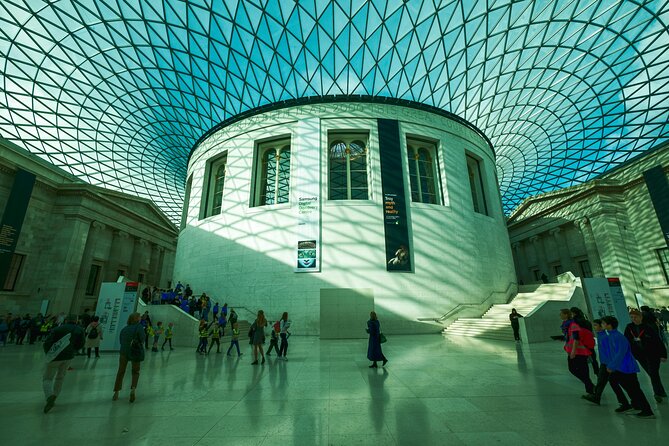
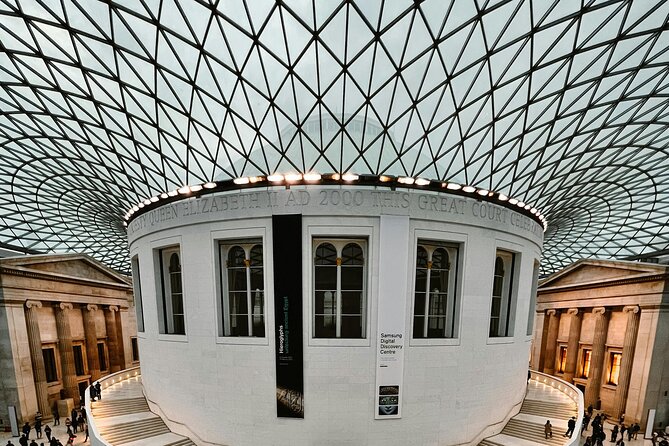
The British Museum is the kind of place where you can wander for hours and still feel like you saw only the entrance. This tour is designed to fix that problem. You move at a guided pace, so you spend less time deciding where to go and more time learning what you’re looking at.
The format also matters: it’s about 2 hours, with the museum ticket included, so you’re not doing extra paperwork or trying to line up timed entry. And because the group is capped at 20, it’s easier for the guide to keep everyone together—and easier for you to get the key points without shouting over a wall of tourists.
Getting started at Great Russell Street
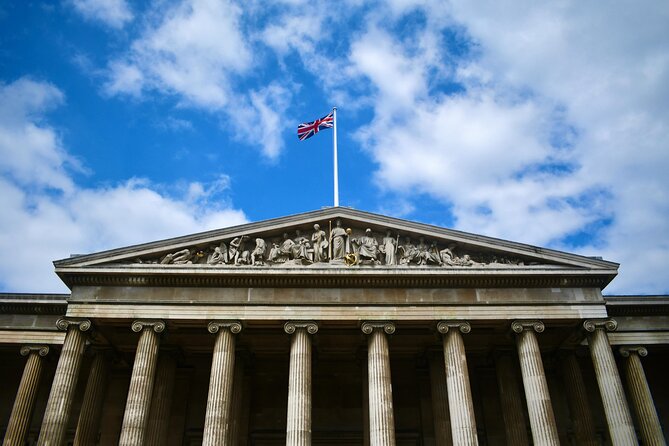
You meet at the British Museum entrance on Great Russell St, London WC1B 3DG. The tour ends back at the same meeting point, which is handy if you’re trying to plug the museum visit into an afternoon of sightseeing nearby.
Two practical things help your experience:
- Go in with comfortable shoes. Even with guidance, you’re still walking between gallery areas.
- If you’re sensitive to noise or language accents, position yourself where you can hear. The group size helps, but the museum can be crowded.
This tour is offered in English, and it’s marked as suitable for most travelers. Service animals are allowed, and it’s near public transportation—so you’re not stuck with complicated transit logistics before or after.
Hans Sloane and the Enlightenment Room: why the British Museum began
A good museum guide doesn’t just show objects; it gives you a way to understand how the museum thinks. The tour starts by putting you in the right frame with the Enlightenment Room and the Hans Sloane Collection.
Sir Hans Sloane wasn’t collecting art in the modern sense. He gathered diverse artefacts and natural specimens, and that range is exactly what this room is about. I like this opening because it answers a quiet question you might have when you walk into the British Museum: why do all these different worlds—Egyptian mummies, Greek marble, African bronzes, even natural specimens—sit under one roof?
You also get a sense of the Enlightenment idea of collecting and categorizing. That context helps later, because you start seeing each object not only as a thing, but as part of a larger story about how people learned, traveled, traded, and documented the world.
Still deciding? A handful more London outings we rated




Rosetta Stone: the fastest way to understand how reading happens
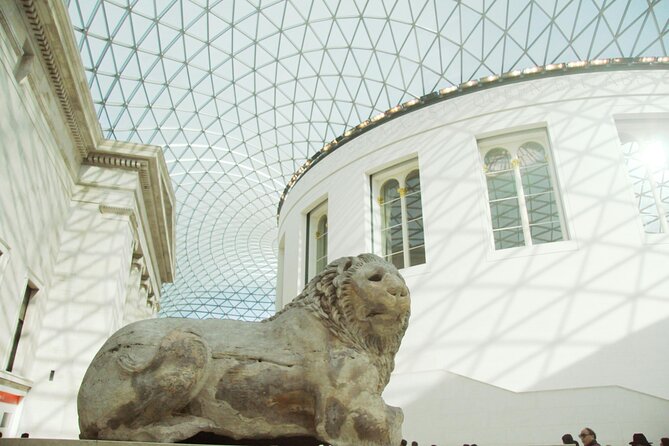
Next up is the Rosetta Stone, presented as the key artefact for deciphering Egyptian hieroglyphs. The value here isn’t just the object. It’s the explanation of why it matters.
When the guide ties the Rosetta Stone to the idea of decipherment, you start to look at it differently. Instead of thinking, Here’s a famous chunk of stone, you start thinking about translation, knowledge transfer, and how scholars cracked a writing system that had been unreadable to many modern eyes.
The tour also includes a later stop focused on the Real Rosetta Stone in the Egypt area. So you get at least two chances to connect the same object to two different parts of the museum’s Egyptian narrative.
King George III Library: where ideas were stored
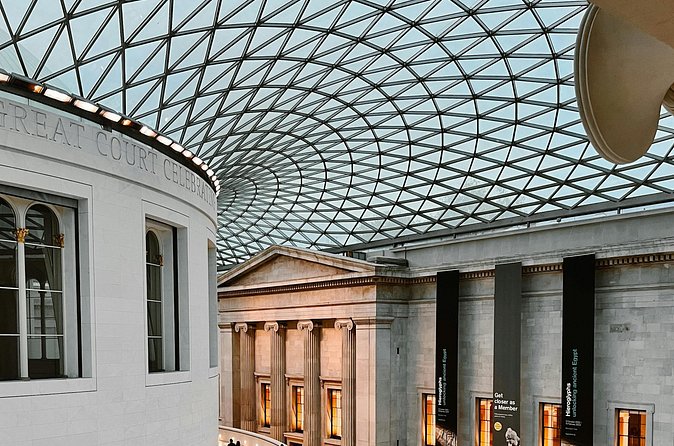
The King George III Library stop is a reminder that museums aren’t only for objects. They’re also for books, research, and the tools people used to make sense of what they found.
Even if you don’t go deep into book history, this is a powerful pause. It helps you see the museum as a place where information is curated through study—an important theme when you’re standing in front of objects whose meanings took time to uncover.
Africa Section and the Hoa Monument: a moai statue in surprising context
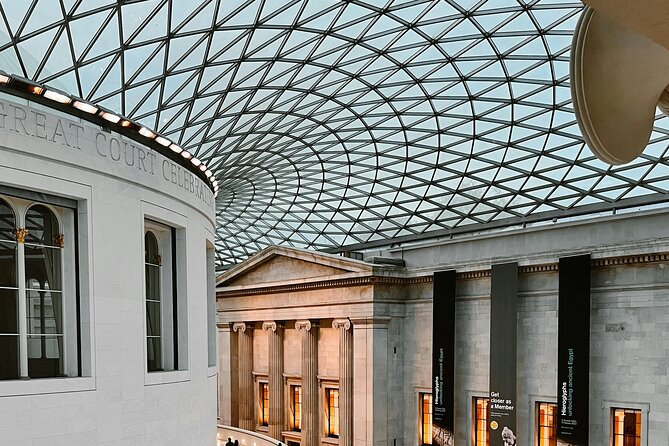
The itinerary includes the Africa Section and the Hoa Monument, described as a striking moai statue from Easter Island.
That detail is exactly the kind of thing a guided route can deliver: you notice the object, but more importantly, you get the context that helps you understand why it appears where it does in this museum setting. A moai in an unexpected gallery can feel odd until you know what the museum is trying to communicate through placement and classification.
Then you move from that moment of surprise into a high-detail stop that anchors this part of the route.
Benin Bronzes: intricate brass that rewards close looking
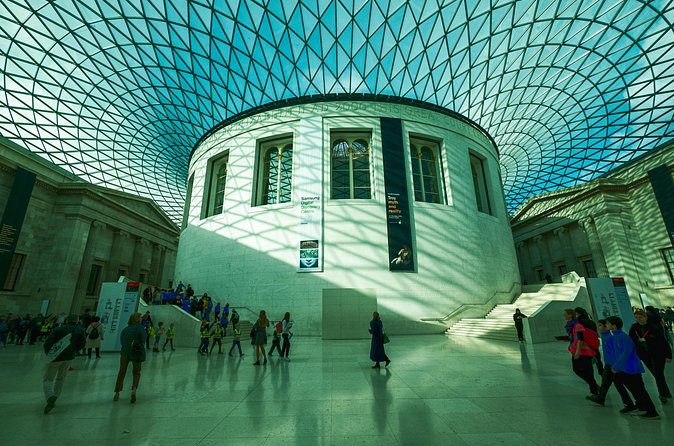
The tour highlights the Benin Bronzes, described as intricate brass plaques and sculptures from the Kingdom of Benin. This is one of those stops where a guide really earns their keep.
Without context, you might rush past details just because you’re scanning for the big items. With a guide, you can slow down and notice craftsmanship you’d miss: how figures are arranged, how surfaces are worked, and how the objects carry meaning beyond decoration.
The Benin Bronzes are also a great example of why a short guided route can outperform a free-for-all. In 2 hours, you don’t have time to study everything. But you can spend concentrated minutes on a few masterpieces and leave with a stronger understanding of what you saw.
Tree of Life: a peace symbol made from decommissioned weapons
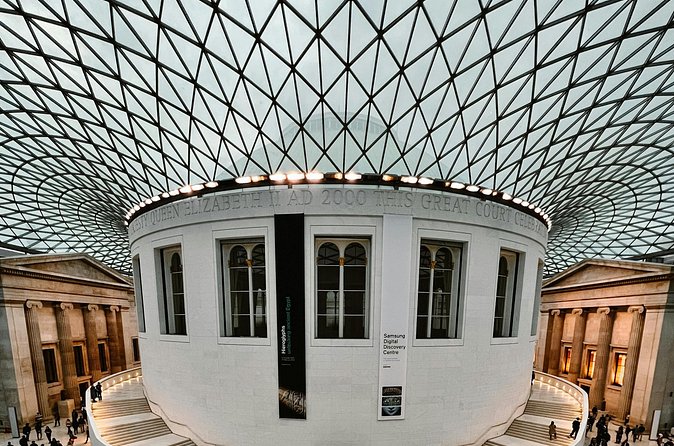
One of the most memorable listed stops is the Tree of Life, a sculpture made from decommissioned weapons, symbolizing peace.
That idea hits hard because it’s not abstract. It’s a transformation story—turning instruments of conflict into something meant to represent healing or renewal. It’s the kind of object that benefits from a guide’s framing because it encourages you to look for the emotional and ethical message, not only the materials.
This stop also breaks up the big survey feel of the tour. After seeing massive-name ancient art, you get a symbolic object that creates a different kind of takeaway.
Egypt Section: Portals of Life and what comes after
The Egypt portion of the route includes exhibits on ancient beliefs about death and the afterlife, described as Portals of Life.
For me, this is where the museum stops being only about chronology and becomes about human belief. Even if you don’t memorize dates, you can understand the psychological purpose behind the objects: what people feared, what they hoped for, and how those hopes were expressed in ritual and imagery.
And because the plan explicitly includes the Real Rosetta Stone again, you keep a thread running between language, knowledge, and belief systems. That repetition can actually be helpful in a short tour—like getting the same concept from two angles so it sticks.
Assyrian Monuments: reliefs that feel like motion
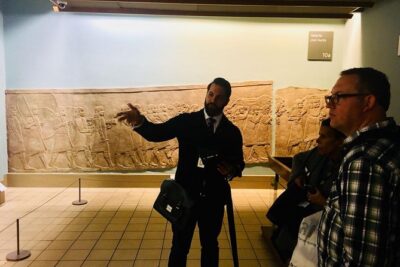
You’ll also see Assyrian Monuments, described as stone reliefs and sculptures. Assyrian art is famous for its sense of action—figures and scenes that look like they’re unfolding.
A guided explanation helps here because you learn what you’re seeing beyond bodies and patterns. In a museum context, reliefs can be easy to skim. With narration, you start noticing motifs and the roles of different figures, which makes the carvings feel more alive and less like wall decoration.
Greeks in Italy and Cyprus: influence you can spot
The itinerary continues with Greeks in Italy and Cyprus, plus a sweep through Greek and Roman material.
This is a smart addition because it shows Greek influence outside Greece itself. Without this context, you might assume Greek art only belongs to Greece. With it, you get a clearer picture of how culture traveled—through trade, migration, politics, and shared tastes.
Parthenon Sculptures (often called Elgin Marbles): seeing marble with context
The tour includes Parthenon Sculptures from Athens, which are often referred to as Elgin Marbles. Even if you’ve seen photos, seeing the sculptures in person can be a different experience. Marble has a way of reading like sculpture and artifact at the same time.
The guide’s job here is to give you context fast enough to matter in a 2-hour visit. In practice, that means learning what the sculptures are, how they relate to the Parthenon, and why they’re treated as such a major part of museum collecting and display.
I like this stop because it’s visually satisfying even for people who aren’t art majors. The shapes are clear; the stories are the part you don’t want to miss.
Romans and Rome: power, copying, and lasting impact
Finally, the tour includes Romans and Rome, focusing on the impact of the Roman Empire. This end section is useful because it ties your earlier stops into a larger arc: how empires copy, adapt, and reuse cultural ideas while stamping them with their own authority.
Again, even if you don’t leave with a perfect timeline in your head, you’ll leave with a stronger sense of how the Mediterranean worlds connect. Egypt, Assyria, Greece, Rome—these aren’t isolated civilizations when you watch how objects and ideas move.
Price and logistics: is $31.55 good value?
At $31.55 per person for about 2 hours, this tour can be a good deal if you’re the kind of visitor who wants clarity instead of wandering.
Here’s why the value works:
- The museum ticket is included, so you’re not stacking costs for entry.
- You get a guided route across multiple major collections, which saves time.
- The group cap at 20 helps keep it from turning into a herd.
Is it a great value if you love total freedom? Maybe not. If you’re the type who wants to linger in one gallery for an hour, a fixed 2-hour plan can feel limiting. But if your goal is to see the museum’s best-known objects with explanations you can actually remember, the price-to-time ratio is attractive.
Choosing your guide style: what to expect from narration
The overall review picture is strong, with a 4.4 rating and 19 reviews. The most praised aspect is the effect a good guide has on the whole visit: people talk about feeling guided rather than lost, and about experts pointing out historic detail you’d probably miss on your own.
The feedback also includes specific guide names. Filomena and Maya come up as standout examples, with comments praising knowledge, enthusiasm, and strong storytelling. That’s a positive sign for you if you want someone who keeps the energy moving.
One consideration is clarity. At least one guest found the accent difficult to understand and felt the tour had too many small stories and side talks. That doesn’t mean the tour is always like that, but it is a real factor to consider if you want tight, factual, easy-to-follow narration.
When this tour fits you best (and when it doesn’t)
This British Museum guided tour is a great match if:
- You want a 2-hour highlights route rather than a full museum day.
- You care about getting context for the Rosetta Stone, Benin Bronzes, and Parthenon sculptures.
- You’re traveling with limited time and want to make the most of an afternoon.
It may not be ideal if:
- You need complete silence to enjoy museums.
- You prefer a self-paced visit where you control every stop.
- You’re very sensitive to language accents or prefer very strict timing with minimal side conversation.
Also, the museum can be crowded in summer, and at least one review notes the building gets full. In those moments, having a guide to keep you moving and pointing matters even more.
Should you book this British Museum Guided Tour?
I’d book it if your goal is practical: you want a well-structured path to the museum’s biggest objects, with a guide helping you connect what you’re seeing. The included ticket, the short duration, and the cap of 20 people make it feel designed for real visitors—not just museum lovers with unlimited time.
I’d skip it or consider a different style tour if you hate fixed routes or you’re looking for deep study of one collection. This experience is about moving smart and learning enough to make the museum feel coherent.
If your schedule is tight and you want the British Museum’s major works without getting lost, this is the kind of plan that turns a complicated visit into something you can actually enjoy.
FAQ
How long is the British Museum guided tour?
The tour lasts about 2 hours.
Is the museum admission included?
Yes, admission tickets are included as part of the tour.
What is the price per person?
The price is $31.55 per person.
Where do we meet for the tour?
You meet at the British Museum, Great Russell St, London WC1B 3DG, UK.
What language is the tour offered in?
The tour is offered in English.
Can I cancel for a full refund?
You can cancel for a full refund if you cancel up to 24 hours in advance of the experience start time.
More Tours in London
- From London: Harry Potter Warner Bros Studio Tour
★ 4.7 · 26,588 reviews - Magical London: Harry Potter Guided Walking Tour
★ 4.7 · 22,044 reviews - London: Warner Bros. Studio Harry Potter Tour & Branded Bus
★ 4.7 · 19,194 reviews - London Big Bus Hop-On Hop-Off Tour with Optional River Cruise
★ 3.5 · 10,803 reviews - London Small Group Tour of Historical Pubs
★ 5.0 · 10,422 reviews
More Tour Reviews in London
- From London: Harry Potter Warner Bros Studio Tour
★ 4.7 · 26,588 reviews - London: Westminster to Greenwich River Thames Cruise
★ 4.5 · 22,836 reviews - Magical London: Harry Potter Guided Walking Tour
★ 4.7 · 22,044 reviews - London: Madame Tussauds London
★ 4.6 · 20,915 reviews - London: Warner Bros. Studio Harry Potter Tour & Branded Bus
★ 4.7 · 19,194 reviews
The British Museum, Continued
- London: British Museum Guided Tour
★ 4.3 · 1,182 reviews - British Museum London Guided Tour Semi-Private 8ppl Max
★ 5.0 · 984 reviews - London: British Museum Guided Tour with Entrance Tickets
★ 4.9 · 748 reviews - London: Tour of the British Museum
★ 4.1 · 678 reviews - London: British Museum Audio Tour & Priority Entrance Ticket
★ 4.5 · 631 reviews
Just reviewed around London





British Museum Tours, compared.
 ★ 4.3British Museum Guided TourFrom $231,182 reviews
 ★ 5.0British Museum London Guided Tour Semi-Private 8ppl MaxFrom $108984 reviews
 ★ 4.9British Museum Guided Tour with Entrance TicketsFrom $39748 reviews
 ★ 4.1Tour of the British MuseumFrom $14678 reviews
 ★ 4.5British Museum Audio Tour & Priority Entrance TicketFrom $9631 reviews
 ★ 5.0The British Museum London – Exclusive Guided Museum TourFrom $108555 reviews
 ★ 4.2Afternoon Tea at the British MuseumFrom $58511 reviews
 ★ 4.0British Museum Guided TourFrom $18470 reviews
Browse the lists this tour appears in