
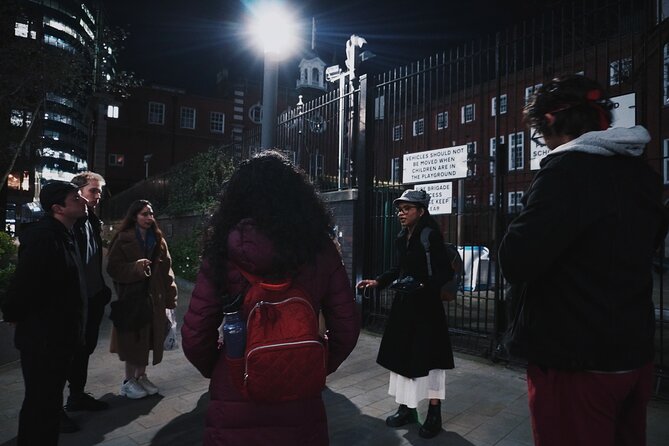
Reviewed · JACK THE RIPPER TOURS
Jack the Ripper: Night Murder Mystery Walking Tour in London
London at night gets eerie fast. This Jack the Ripper walking tour makes Whitechapel feel like a live mystery, with a guide in a Ripperologist role and a hands-on crime-scene challenge; I especially love the chronological route and the focus on the women victims, not just the killer. One drawback: it is a lot of walking, and on a windy night you may find it’s sometimes hard to hear if you’re not near the front.
You’ll move through key street corners and courtyards tied to the case, then end with a pub stop at the Ten Bells in Whitechapel. It runs about 2 hours 30 minutes, costs $22.93 per person, and keeps groups to a maximum of 25—small enough to stay together, big enough for a lively night.
If you’re booking soon, you’ll be glad to hear it gets reserved quickly (on average, about a month ahead). You’ll also get a mobile ticket, and confirmation comes right when you book, so you can stop stressing and focus on the streets.
In This Review
- Key things I’d plan around
- Whitechapel after dark: what this tour feels like in 2.5 hours
- Brick Lane’s Victorian backdrop: why the streets mattered
- Princelet Street and Puma Court: narrow streets where people vanished
- Gunthorpe Street: the case theory starts with Martha Tabram
- Ten Bells in Whitechapel: the pub stop that anchors the night
- Goulston Street and the chalk controversy: the clue that won’t stay quiet
- St Botolph without Aldgate: a refuge and a verdict on society
- Ending at Mitre Square: where the story lands for Mary Jane Kelly
- Price and value: $22.93 for a guided night in Whitechapel
- Who this walking tour suits best
- Small practical tips so you get the best night
- Should you book this Jack the Ripper night tour?
- FAQ
- How long is the Jack the Ripper night mystery walking tour?
- What does the tour cost?
- What language is the tour offered in?
- What are the start and end locations?
- How big is the group?
- Is there admission included for the stops?
- Can I cancel for a full refund?
Key things I’d plan around
- Interactive mystery solving: you don’t just listen; you work through clues as you go.
- A chronological story arc: the timeline is kept clear so the case builds logically.
- Victims-first tone: the stops bring in the lives and conditions of the women targeted.
- Short stops, steady pace: each location is brief, so come ready to walk.
- Ten Bells finale: you finish where the case is strongly linked in local telling.
- Hearing can be hit-or-miss: if you prefer close-up commentary, position yourself well early.
More of the East End after dark
- London: The Original Jack the Ripper Walking Tour
★ 4.7 · 7,833 reviews - London Jack the Ripper Guided Tour with Ripper-Vision
★ 4.5 · 4,840 reviews - London: Jack the Ripper Small Group Tour
★ 4.7 · 3,159 reviews - London Jack The Ripper Guided Walking Tour
★ 5.0 · 3,131 reviews
Whitechapel after dark: what this tour feels like in 2.5 hours
This tour is built for an evening mood. You start at St Marys Whitechapel Church Memorial in London E1 1FE, then work your way across the area connected to the murders, ending at Mitre Square in EC3A 5DE, where Mary Jane Kelly’s story ends in the way the tour presents it.
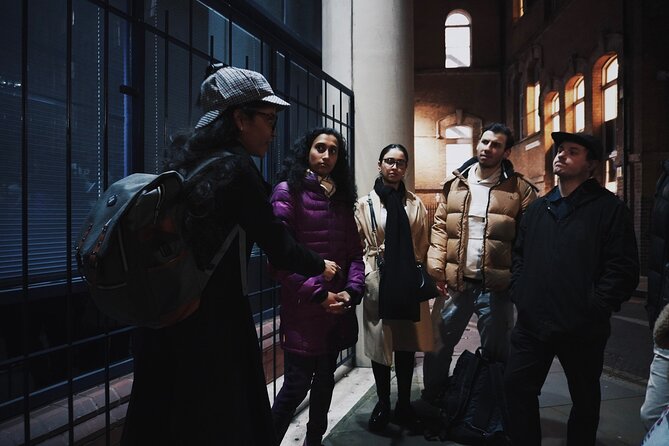
The style is “night out with a purpose.” The guide takes on the Ripperologist persona and keeps things moving with an interactive mystery format, so you’re not stuck passively waiting at every corner. Expect short stretches of walking between stops, with about 17 minutes at each location mentioned in the route.
The group limit matters. With up to 25 people, you’re more likely to stay in sync rather than lose the thread when the street gets crowded with other nighttime walkers. It also helps the “solve the mystery together” part actually feel like a group activity.
Brick Lane’s Victorian backdrop: why the streets mattered
You kick off in Brick Lane, now known for food, markets, and culture. In the tour’s telling, it also served as part of the heart of Victorian slum life, where extreme poverty, overcrowding, and daily desperation formed the grim setting for the crimes.
This stop works well even if you’re new to the case. You get a practical sense of why Whitechapel is more than a set of dark alleyways—it was a place where vulnerability was common and anonymity was easy.
If you hate long speeches, you’ll still be fine here. The stop is short, and the point is to set the stage before the route starts tightening around specific locations.
Princelet Street and Puma Court: narrow streets where people vanished
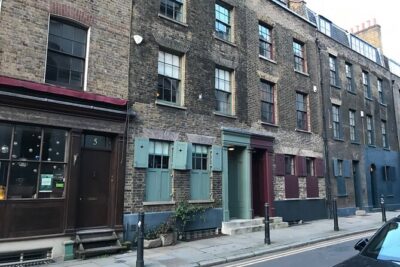
Next comes Princelet Street, described as quiet and narrow. It’s the kind of street where it’s easy to imagine how someone could slip away without being noticed, and the tour connects the area to the living conditions women faced—specifically calling out Annie Chapman.
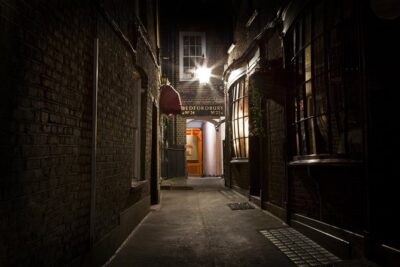
Then you move to Puma Court, which the tour frames as almost unchanged since the 19th century. That detail is what makes this stop more than a name on a map. When the physical setting stays familiar, the story feels less like a lecture and more like a scene you can picture.
One practical note: narrow streets can feel louder in some spots and muffled in others. If your group gets bunched up, angle yourself so you can hear clearly when the guide starts linking clues to the layout around you.
London on foot, a few more ways


Gunthorpe Street: the case theory starts with Martha Tabram
Gunthorpe Street is where the tour turns toward one of the most discussed early theories: Martha Tabram. The route calls this passage narrow and ominous, and it frames her murder as possibly the Ripper’s first victim in some expert lists.
This stop is a good example of what the tour does well: it doesn’t treat the Ripper as a single myth. Instead, it shows how the story is built from competing interpretations—what people believe happened, what evidence people point to, and why some historians include (or exclude) certain names.
If you’re the kind of person who likes “why people disagree,” you’ll probably enjoy Gunthorpe Street. The tone here is more about understanding the reasoning than chasing shock.
Ten Bells in Whitechapel: the pub stop that anchors the night
The tour’s midpoint-to-finale shift happens at the Ten Bells. The big idea is that many victims were believed to have visited this pub shortly before their deaths, so the guide uses the location to talk through what those final hours might have looked like.
Finishing here is also a mood reset. After street corners and crime-scene talk, the pub gives you a familiar landmark. Even if you don’t order anything, it helps you breathe, swap quick thoughts with your group, and mentally connect the dots between stops.
The tour then wraps up after this pub-linked ending point, guiding you onward to the final location at Mitre Square. If you’re a fan of closure, this design helps: you leave with one last defined place tied to Mary Jane Kelly’s story.
Goulston Street and the chalk controversy: the clue that won’t stay quiet
Goulston Street is one of the stops that brings the controversy into focus. The tour describes a bloody piece of apron associated with Catherine Eddowes, plus a chalk message nearby that sparked disputes and conspiracy theories that still linger.
This is a great stop for anyone who likes crime stories with unresolved edges. You’re not just getting names and dates; you’re seeing how small pieces of information become big debates—especially when documentation is limited and memories of events get filtered through rumors.
Also, this stop is a reminder of how the case has grown over time. The tour’s approach helps you separate what’s tied to specific physical details from the parts that people interpret and argue about.
St Botolph without Aldgate: a refuge and a verdict on society
St Botolph without Aldgate adds a different emotional weight to the walk. In the tour’s framing, it’s known as a haunt for vulnerable women seeking refuge, and it serves as a pause for reflection on how Victorian society failed the women later known as the Ripper’s victims.
This stop is why the tour often feels respectful rather than sensational. The focus stays on vulnerability and survival, not just the legend of the killer.
It also gives your feet a breather. Even though you’re still outside and moving, the pacing here shifts toward reflection, which helps the whole night feel more grounded.
Ending at Mitre Square: where the story lands for Mary Jane Kelly
The tour ends at Mitre Square, which the route connects to Mary Jane Kelly’s death. This isn’t just a random final pin on a map—it’s where the tour’s timeline closes.
If you like when a story has an ending point, you’ll like the structure. Going in order from one site to the next keeps the case from turning into a list of spooky locations.
One thing to keep in mind: because the route is designed for time, you won’t have long breaks at most stops. Plan on standing and listening for short bursts, then walking again.
Price and value: $22.93 for a guided night in Whitechapel
At $22.93 per person, this tour sits in the pocketbook-friendly zone for London evening activities. The value comes less from the low price and more from what you get for it: a structured route, a guide who stays in character, and an interactive clue-solving format.
You also don’t face surprise admission costs at the locations listed in the route—each named stop shows free admission. That keeps the cost predictable, which matters more than a bargain price when you’re planning a full trip schedule.
Duration is about 2 hours 30 minutes, which is long enough to feel like you did something meaningful, but not so long that it turns into a marathon in the cold.
Who this walking tour suits best
This is a strong match if you’re into true crime, London history, and street-level storytelling. It’s also ideal if you like group activities where you can participate, not just listen.
You’ll likely enjoy it if you want the case told with a clear sequence and a careful tone for victims. The tour’s emphasis on the women targeted—plus the focus on living conditions—makes the night feel human instead of purely gothic.
If you’re sensitive to heavy topics, it’s still worth knowing the subject matter is dark. The tour aims for respect, but it’s built around violent deaths, so go in ready for that reality.
Small practical tips so you get the best night
- Wear grippy shoes. You’re walking for 2.5 hours at night, and the street surfaces can vary.
- Position yourself closer to the guide early. A few people note hearing can be tougher when the guide moves or the group shifts.
- Bring a layer. It’s an evening walk, and chilly weather changes how long you stand still.
- Be ready for standing. Most stops are short, and there are limited opportunities to sit before the end.
- Plan to stay with the group. Narrow streets make it easy to fall behind, and the tour is designed for everyone to stay together.
Should you book this Jack the Ripper night tour?
If you want a low-cost, well-paced way to see Whitechapel after dark, this tour is a solid pick. The best reasons to book are the interactive clue format, the chronological telling, and the way the route keeps returning to the victims and their circumstances, not just the legend.
Skip it if you hate walking or you’re very sensitive to being cold and standing outside for short stops. Also, if you struggle to hear in noisy outdoor settings, choose your spot carefully at the start so you don’t miss the details when the guide explains the clues.
If you book, aim to arrive ready to walk, and treat it like an evening mystery walk first—history lesson second.
FAQ
How long is the Jack the Ripper night mystery walking tour?
The tour is about 2 hours 30 minutes.
What does the tour cost?
The price is $22.93 per person.
What language is the tour offered in?
The tour is offered in English.
What are the start and end locations?
It starts at St Marys Whitechapel Church Memorial on an unnamed road in London E1 1FE, and it ends at Mitre Square in London EC3A 5DE. The tour wraps up at the Ten Bells Pub in Whitechapel.
How big is the group?
The tour has a maximum of 25 travelers.
Is there admission included for the stops?
Each of the listed stops shows free admission.
Can I cancel for a full refund?
Yes, cancellation is free up to 24 hours in advance for a full refund. If you cancel within 24 hours of the start time, the amount you paid is not refunded.
More Games and Escape Rooms
- London: Sherlock Holmes-Themed Walking Tour
★ 4.7 · 756 reviews - Sherlock: The Official Live Game
★ 4.5 · 460 reviews - Moriarty’s Game: The Professor’s Invitation by HiddenCity
★ 5.0 · 445 reviews - The Hunt for the Cheshire Cat by HiddenCity
★ 5.0 · 225 reviews - Sherlock Holmes Walking Tour in London
★ 5.0 · 207 reviews
More London Walks Worth the Shoe Leather
- Magical London: Harry Potter Guided Walking Tour
★ 4.7 · 22,044 reviews - London: The Original Jack the Ripper Walking Tour
★ 4.7 · 7,833 reviews - Tour for Muggles The Ultimate Harry Potter Walking Tour in London
★ 5.0 · 4,684 reviews - London Jack The Ripper Guided Walking Tour
★ 5.0 · 3,131 reviews - London: Harry Potter Movies Walking Tour (Kids Go Free)
★ 4.7 · 3,071 reviews
More Ripper Walks After Dark
- London: The Original Jack the Ripper Walking Tour
★ 4.7 · 7,833 reviews - London Jack the Ripper Guided Tour with Ripper-Vision
★ 4.5 · 4,840 reviews - London: Jack the Ripper Small Group Tour
★ 4.7 · 3,159 reviews - London Jack The Ripper Guided Walking Tour
★ 5.0 · 3,131 reviews - London: Jack the Ripper Tour with Immersive Ripper Vision
★ 4.5 · 1,840 reviews
Just reviewed around London





Jack the Ripper Tours, compared.
 ★ 4.7The Original Jack the Ripper Walking TourFrom $257,833 reviews
 ★ 4.5London Jack the Ripper Guided Tour with Ripper-VisionFrom $274,840 reviews
 ★ 4.7Jack the Ripper Small Group TourFrom $263,159 reviews
 ★ 5.0London Jack The Ripper Guided Walking TourFrom $03,131 reviews
 ★ 4.5Jack the Ripper Tour with Immersive Ripper VisionFrom $241,840 reviews
 ★ 4.6German Language : Original Jack the Ripper TourFrom $241,805 reviews
 ★ 5.0Ultimate Jack the Ripper : Guided Tour of LondonFrom $271,495 reviews
 ★ 4.9Jack the Ripper Evening Walking TourFrom $331,449 reviews
Browse the lists this tour appears in