
Reviewed · STREET ART
East End London Instagrammable Street Art and Graffiti Tour
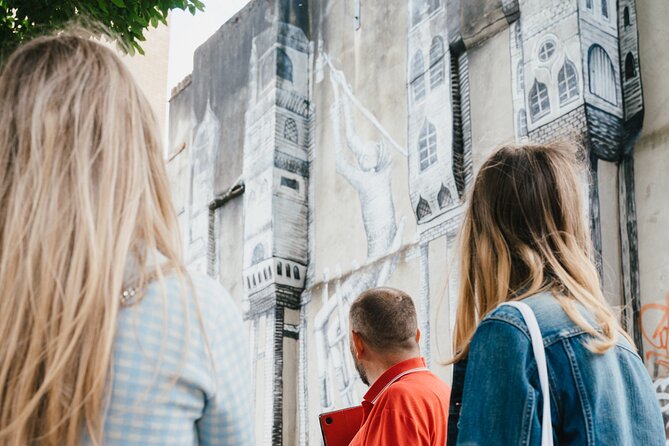
London graffiti is a scavenger hunt for photos. This East End walk is built around photo angles and street stories, from giant murals to tucked-away walls that most people never find. I like that the guide points out what to notice up close, including big-name artists like Banksy, plus the smaller details that make your photos look like you planned them.
My favorite part is the hands-on element. You’re not just watching street art—you’ll get a chance to make your own by the end, which feels like a proper souvenir you can’t buy in a shop.
One thing to keep in mind: much of what you see is outdoors and can shift fast. Stickers and some smaller pieces change often, so the exact look depends on timing, and the walk is a steady 2 hours of moving through side streets and yards.
In This Review
- Key highlights you’ll care about before you go
- East End London graffiti: what this tour is really like
- Price and timing: is $49 worth it for 2 hours?
- Stop-by-stop: the East End walls you’ll actually want to photograph
- Heneage Street: Phlegm’s stilts and FanakaPan’s balloon twist
- Brick Lane: door-sized Dan Kitchener and Perspicere
- The Seven Stars yard: stickers as the main event
- Princelet Street: Stik’s resilience for the local community
- Hanbury Street: ROA’s bird and Martin Ron’s handstand
- Dray Walk: broccoli becomes a neighborhood signature
- Allen’s Gardens and Buxton Street: letter walls and collaborations
- Ebor Street: Neon portraits, Ben Eine letters, and that clean read
- Rivington Street: the Banksy glass panel debate
- Rivington Street again: Otto Schade’s ribbon soldier and stencil energy
- Thierry Noir’s colourful heads: bright characters with long roots
- art’otel London Hoxton: Banksy’s wall brought back to the street
- Hewett Street: Shakespeare’s bench and Romeo and Juliet graffiti
- New Inn Broadway: one building as a multi-artist wallpaper
- Shoreditch High Street: the graffiti wars finale
- Should you book the East End Instagrammable Street Art and Graffiti Tour?
- FAQ
- How long is the East End London Instagrammable Street Art and Graffiti Tour?
- How much does the tour cost?
- What time does the tour start?
- Where do I meet the guide, and where does the tour end?
- How large is the group?
- Do I get a mobile ticket?
- Is making your own street art included?
- Will the tour include Banksy?
- Is the tour free to cancel, and are service animals allowed?
Key highlights you’ll care about before you go
- Banksy on the Rivington Street route, including a spot where older works are shown behind glass and you can talk art and the art market
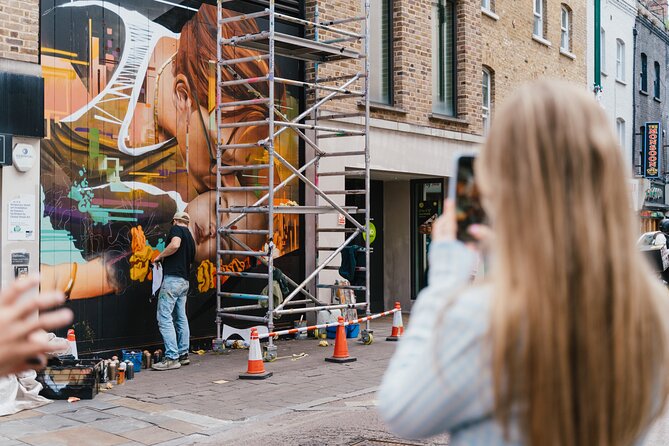
- Big-mural photo practice, with a guide steering you toward angles where doors, building sides, and walls make sense in one frame
- Street art that has staying power, including works noted as being around 20 years old and pieces that get repainted after defacing
- The goofy-to-famous East End mix, from Adrian Boswell’s broccoli trend to Shakespeare appearing right alongside graffiti
- A small-group pace, capped at 20 people, which helps you stop without the pack crushing your photo angles
- A make-your-own moment, so you leave with something more than pictures
Still deciding? A handful more London outings we rated
- London: Street Art and Graffiti Guided Walking Tour
★ 4.9 · 1,354 reviews - London Bike Tour: Landmarks, Secret Gems, Pub Stop & Street Art
★ 5.0 · 943 reviews - Shoreditch Street Art Tour London
★ 5.0 · 481 reviews - London: Landmarks & Secrets Bike Tour with Pub & Street Art
★ 4.9 · 314 reviews
East End London graffiti: what this tour is really like
This is a guided walking tour focused on East End street art and graffiti. The main goal is simple: you’ll see major murals, plus the smaller layers—stickers, stencils, tags, and painted letters—that make the neighborhood feel like a living gallery.
You’ll also walk in a way that helps your photos. Instead of just pointing at walls, the guide nudges you to step back, look down, then look up, so the art reads clearly in your frame. It’s especially helpful for door-sized pieces and large works that only make sense from one particular spot.
At $49 per person for about 2 hours, it’s also good value for what you get. You’re paying for a local guide, access to photo angles and context, and time to do a street art activity—while each stop is described as admission free.
This tour often books ahead. If you’re traveling in a busy period, I’d treat it like a plan-first kind of activity and try to lock your date early, since it’s commonly reserved about 91 days in advance.
Price and timing: is $49 worth it for 2 hours?
The price is $49 per person, with the experience running about 2 hours. That’s long enough to cover a lot of ground on foot, but short enough that you’re not stuck in one zone all day.
Here’s what makes the cost feel more justified than a random self-guided photo walk. You get a local guide to translate what you’re seeing, including graffiti wars stories and why certain artists and styles matter. And you don’t just browse—there’s an opportunity to create your own street art, which gives the tour a practical payoff.
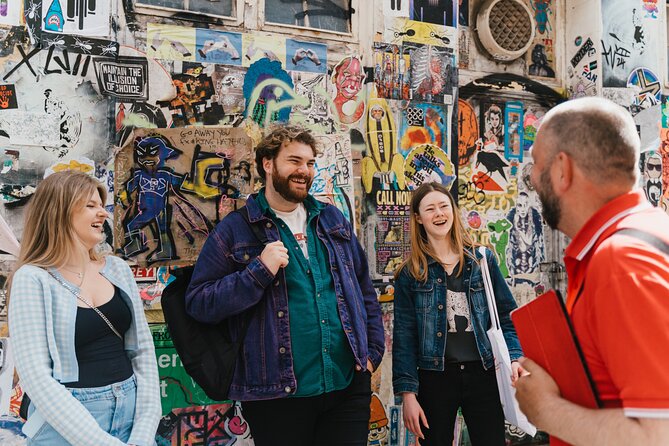
Also, the group size is capped at 20 travelers. In street art spots, space matters: you need room to step back for scale, and you need a second or two to compose a shot without someone standing in front of the art.
Stop-by-stop: the East End walls you’ll actually want to photograph

Heneage Street: Phlegm’s stilts and FanakaPan’s balloon twist
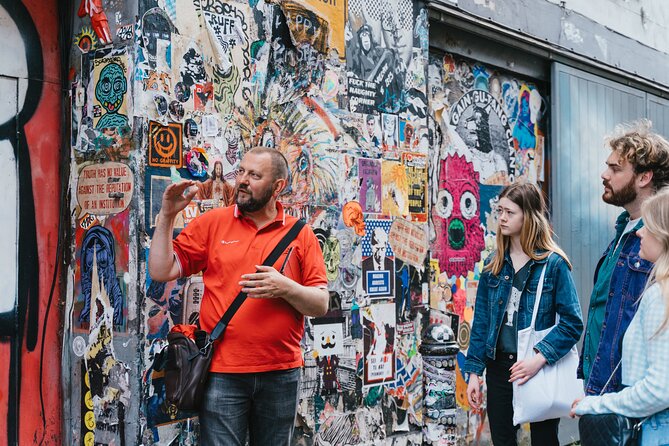
You start at 80 Whitechapel High St at 11:00am, and early on the tour does a smart thing: it gets you into the mindset of hunting. The first stop, Heneage Street, is hidden away in small backyards, which means you’re seeing work most people miss because it’s not on the main sidewalk.
Two huge pieces take over a whole building wall. One is by Phlegm, with long slim creatures walking on stilts, layered above tags from other artists. What I like here is the sense of height and motion; even if you’re not an art nerd, your eye can’t help but follow the lines upward.
Across the street—again, in a tucked-away location—you’ll find FanakaPan. Their silver, helium balloon figures feel playful and slightly off-kilter, like a classic idea that gets a new twist. This is a stop where you’ll want to pause and look up, then try a shot from a slightly lower angle to emphasize the scale.
Brick Lane: door-sized Dan Kitchener and Perspicere
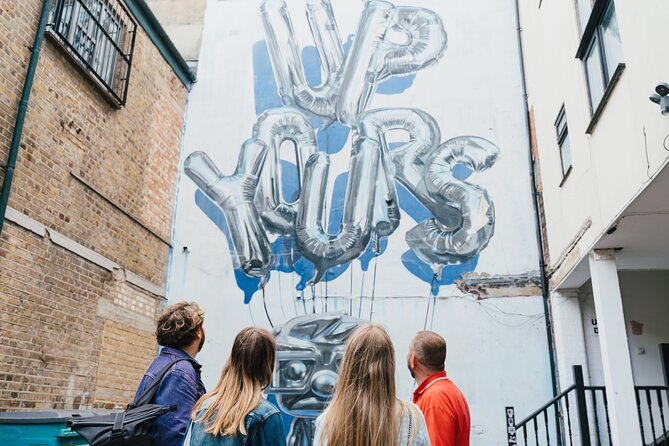
Next you reach Brick Lane, and the guide uses a photo trick that you can copy later. Sometimes you need distance to appreciate a mural, but other times you need distance to avoid over-cropping door art.
Here you start from a distance to look at works by Dan Kitchener and Perspicere. Their pieces are on doors, so the format is smaller than a street-wall mural, yet the art demands attention. The guide helps you spot the technical details, so you’re not just taking a quick picture—you’re learning what makes the work work.
One practical drawback: Brick Lane can have more foot traffic than the back streets. It’s still manageable, but plan on waiting a minute for a clear shot if people are passing in front of the doors.
The Seven Stars yard: stickers as the main event
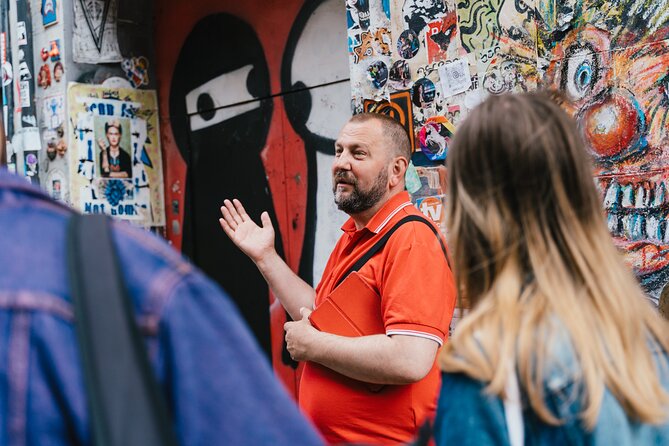
Turning from the street into a narrow yard can feel like you’re walking into a secret pocket. That’s part of the point. At The Seven Stars, stickers become the star, and the guide encourages you to see stickers as its own art world.
You’ll look for small details, not just big images. This stop is also where you get more direct encouragement to participate—there’s a moment described as becoming the eighth star and leaving a little art of your own.
If you like street art because it feels personal, sticker culture is a good place to see that. You get the layered, messy charm of pieces that people place because they want to share—not because they’re trying to be perfect.
Princelet Street: Stik’s resilience for the local community
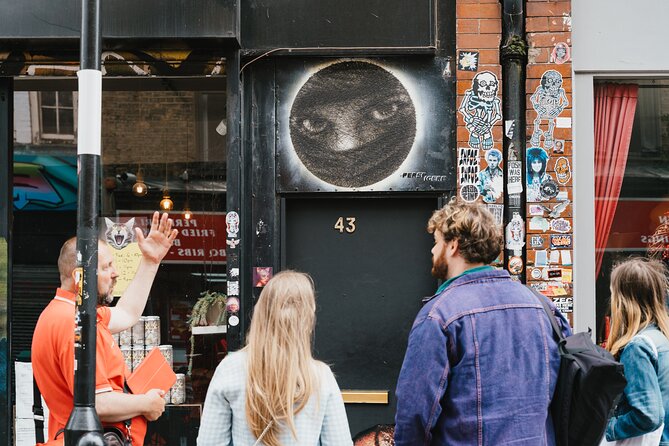
At Princelet Street, you’ll see a piece tied closely to local community. The guide frames it in the context of Shoreditch’s history with refugees and immigrants who made the area home.
The work is by Stik and is dedicated to the Muslim community. The important detail is that it’s been defaced at times, but always repainted. That gives the mural a clear message: the art isn’t just decorative, it’s protected by the community’s willingness to restore it.
Drawback-wise, defaced sections can make photos a little unpredictable. Still, that’s also the real lesson: street art here isn’t museum-clean, and the repaints show the neighborhood’s ongoing relationship with the work.
Hanbury Street: ROA’s bird and Martin Ron’s handstand
On Hanbury Street, the tour steers you toward a huge bird in a side street. When you get close, you realize there’s more than one story at once: stickers, black-and-white painted slogans by Wrdsmth, and smaller colourful graffiti that can change quite often.
Then you’ll focus on two long-running classics: the bird by ROA and the upside-down man by Martin Ron. The tour notes these have been around for about 20 years, and it treats that as ancient by graffiti standards, which puts their “staying power” into perspective.
The man-on-his-hand piece is especially impressive because it uses existing features of the building. In your photos, that’s the trick—look for how the art aligns with the surface shapes around it. If you stand in the wrong spot, it can feel like a stunt. From the right angle, it reads as real skill.
Dray Walk: broccoli becomes a neighborhood signature
Then comes the most “wait, really?” stop: Dray Walk and its broccoli trend. The guide points out that some broccoli are realistic, while others are rainbow-colored, and they’ve been appearing on this street for years.
This one is attached to the wall, and the guide says the trend was so strong it changed the street’s name to Broccoli Lane. It’s whimsical, yes, but also useful because it shows how graffiti and street art become local identity, not just random decoration.
The artist associated with starting the trend is Adrian Boswell, who has his own gallery and even sells broccoli in frames. So if you like this vibe, you’re not just seeing a joke—you’re seeing a street idea that matured into a whole brand.
Allen’s Gardens and Buxton Street: letter walls and collaborations
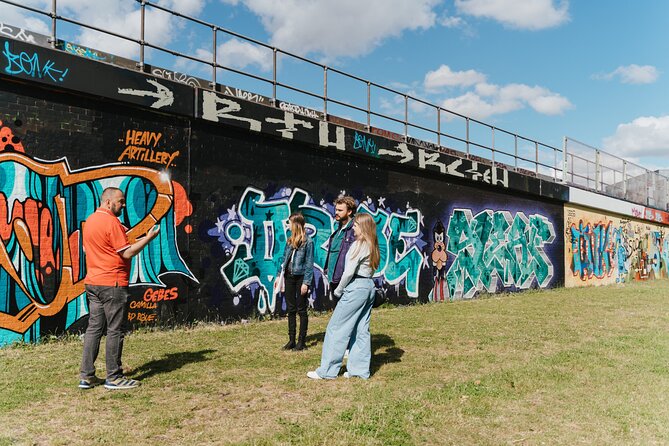
At Allen’s Gardens, you move a bit further from the main street into a graffiti park setting. This matters because it’s a different kind of space: walls surrounded by more walls, giving writers room to stack layers without the same street constraints.
The tour warns you that some of the art changes every few days. That’s why this is such a photo-friendly stop—if you visit when the walls are freshly updated, your images will look extra “current.” If you visit later, the colours might still be great, but the exact composition can shift.
Most of what you’ll see here is by writers who paint letters. The guide frames it as a challenge because the letters are hard to read on purpose—almost like abstract colourwork. If you’ve ever wanted graffiti to be about style rather than legibility, this is the place.
Then you head toward Buxton Street, which features collaborations—work made by two or more artists. There’s also a moment where you look up for the number 5 and connect it to an artist’s recognizable style, plus learn about newer additions nearby. It’s a quick stop, but the takeaway is good: East End street art isn’t just single-artist masterpieces; it’s often teamwork and follow-on styles.
Ebor Street: Neon portraits, Ben Eine letters, and that clean read
Ebor Street is a turn toward the trendy, modern part of the area, while still staying graffiti-saturated. The tour keeps the pacing smooth here, moving you between large painted adverts and smaller pieces.
At one Ebor Street stop, you’ll see large-format advert-style works painted by graffiti artists, plus smaller pieces such as pink portraits by Neon. The guide describes these faces as like a gentle mist of spray paint that lands exactly where it should, creating characters with real personality.
Then you stay on Ebor Street for another angle: Ben Eine and his big bold letters. This is the “easy to read from a distance” side of graffiti, which is great for photos if you don’t want to play detective with tiny details.
The tour notes that Ben Eine’s letters keep the same overall style, but he uses different fonts across works. Some are old-fashionedly curved and elaborate; others are sharp and modern; some are just square. It’s a fun shift because it shows graffiti can be both expressive and instantly readable.
Rivington Street: the Banksy glass panel debate
If you want a major name, this is where you’re meant to find it. On Rivington Street, you’ll visit a secret place where there are old Banksy works shown alongside less-known but still outstanding street art.
Here’s a specific detail that changes how you experience it: the Banksy pieces are covered by a glass panel. The guide doesn’t treat it as a simple yes-or-no. You’re encouraged to talk about whether it’s right, what glass does to meaning, and how you feel about the art market and trends.
This stop is valuable even if you don’t care about Banksy as a celebrity. The glass panel turns it into a question: is it still street art if it’s protected and displayed? Thinking about that while looking at the art makes the whole tour stick in your mind.
Rivington Street again: Otto Schade’s ribbon soldier and stencil energy
Next on Rivington Street, you’ll spot half of a soldier. You won’t get the full view until you stand on the corner in the right spot. The work is by Otto Schade, and the tour points out that his pieces tend to look like they’re made out of ribbons.
The “empty inside but full of life” effect comes from stencil technique and shape. In photos, this can be tricky: if your angle is wrong, you lose the ribbon structure. If you get it right, you’ll capture that sense of motion without needing a video.
Thierry Noir’s colourful heads: bright characters with long roots
Still on Rivington Street, you’ll then meet Thierry Noir. The tour frames him as brightening walls with colourful heads for more than 40 years. He’s best known for groundbreaking work on the Berlin Wall in the 1980s, but he’s also left marks in London.
This is the kind of street art that works in any weather. Even on a gray day, those faces help your mood while you keep walking. It’s also a nice reminder that street art didn’t start in London just yesterday—it has deep roots in Europe’s visual culture.
art’otel London Hoxton: Banksy’s wall brought back to the street
At art’otel London Hoxton (Powered by Radisson Hotels), you’ll see an “archaeological” moment of street art. The tour explains that a Banksy wall painted long ago was taken from its original spot and then reinstated so people can admire it again.
Because it’s part of a newer artsy hotel, this stop can feel like a collision between street culture and modern design. Still, the key practical point is that you don’t need to book a room to see it—the work is out on the street where everyone can view it and form their own opinion.
Hewett Street: Shakespeare’s bench and Romeo and Juliet graffiti
At Hewett Street, you get a left-turn into literary London. The guide points out the Curtain Theatre, tied to William Shakespeare.
You’ll find Shakespeare quietly sitting on a bench marking the theater grounds. The fun detail is that when you sit next to him, you’ll notice a graffiti of Romeo and Juliet, described as the place where people first heard that immortal love story.
This stop is useful because it links street art to something older: storytelling. You’re not only photographing colourful paint; you’re standing in a place connected to how stories became popular in the first place.
New Inn Broadway: one building as a multi-artist wallpaper
From romance to pure colour. At New Inn Broadway, the tour points you to a big building covered by many artists.
You’ll see different colour palettes, different styles, and even a small policeman mixed into the overall scene. The effect is like graffiti wallpaper, and it’s a good place to practice quick framing because you’ll likely want multiple photos: one wide shot for the whole wall and one tighter shot for specific characters.
Shoreditch High Street: the graffiti wars finale
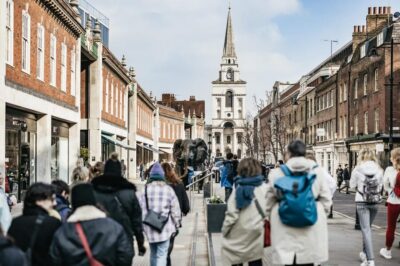
Finally, you move toward Shoreditch High Street, where the tour shifts from the older, rougher feel toward the glass-and-metal skyscrapers of the City. It’s a visual reminder that this part of London is changing fast.
Before the end, you’ll hear a last story about the Graffiti Wars—the guide describes it as serious, even if the outcome is that some wonderful art came out of it. The takeaway is that street art often grows in tension, and the walls become records of those moments.
Should you book the East End Instagrammable Street Art and Graffiti Tour?
I’d book it if you want a guided way to see street art that’s more than just famous names. The combination of photo-focused stops, context on why the art exists, and a chance to make your own piece gives it real value for $49.
You should also book it if you like variety. The route includes sticker culture, stencils, letter styles, big-name murals, plus quirky local signatures like broccoli. And the Banksy section has an explicit discussion element, which makes the experience feel more thoughtful than a simple photo hunt.
Skip it if you hate walking or you only want polished, museum-style art. This is about the street: narrow yards, side streets, walls that change, and art that sometimes gets defaced and repainted. If that’s your style, you’ll have a great time.
One more practical note: with a start time at 11:00am and a small group cap of 20, I’d plan to arrive a few minutes early so you can settle in without stress.
FAQ
How long is the East End London Instagrammable Street Art and Graffiti Tour?
It runs for about 2 hours.
How much does the tour cost?
The price is $49.00 per person.
What time does the tour start?
The start time is 11:00am.
Where do I meet the guide, and where does the tour end?
You meet at 80 Whitechapel High St, London E1 7QX, UK, and the tour ends within walking distance of Liverpool Street Station in London EC2M 7QA, UK.
How large is the group?
This tour has a maximum of 20 travelers.
Do I get a mobile ticket?
Yes, the tour uses a mobile ticket.
Is making your own street art included?
Yes. The tour includes an opportunity to make your own street art.
Will the tour include Banksy?
Yes. The tour includes Banksy and describes a secret place where you can see older Banksy works.
Is the tour free to cancel, and are service animals allowed?
Free cancellation is offered, with full refunds if you cancel up to 24 hours in advance of the experience start time. Service animals are allowed.
More Street Art in London
- London: Street Art and Graffiti Guided Walking Tour
★ 4.9 · 1,354 reviews - London Bike Tour: Landmarks, Secret Gems, Pub Stop & Street Art
★ 5.0 · 943 reviews - Shoreditch Street Art Tour London
★ 5.0 · 481 reviews - London: Landmarks & Secrets Bike Tour with Pub & Street Art
★ 4.9 · 314 reviews - The Original London Street Art Tour
★ 5.0 · 303 reviews
More Tours in London
- From London: Harry Potter Warner Bros Studio Tour
★ 4.7 · 26,588 reviews - Magical London: Harry Potter Guided Walking Tour
★ 4.7 · 22,044 reviews - London: Warner Bros. Studio Harry Potter Tour & Branded Bus
★ 4.7 · 19,194 reviews - London Big Bus Hop-On Hop-Off Tour with Optional River Cruise
★ 3.5 · 10,803 reviews - London Small Group Tour of Historical Pubs
★ 5.0 · 10,422 reviews
More Tour Reviews in London
- From London: Harry Potter Warner Bros Studio Tour
★ 4.7 · 26,588 reviews - London: Westminster to Greenwich River Thames Cruise
★ 4.5 · 22,836 reviews - Magical London: Harry Potter Guided Walking Tour
★ 4.7 · 22,044 reviews - London: Madame Tussauds London
★ 4.6 · 20,915 reviews - London: Warner Bros. Studio Harry Potter Tour & Branded Bus
★ 4.7 · 19,194 reviews
Just reviewed around London





Street Art, compared.
 ★ 4.9Street Art and Graffiti Guided Walking TourFrom $331,354 reviews
 ★ 5.0London Bike Tour: Landmarks, Secret Gems, Pub Stop & Street ArtFrom $104943 reviews
 ★ 5.0Shoreditch Street Art Tour LondonFrom $29481 reviews
 ★ 4.9Landmarks & Secrets Bike Tour with Pub & Street ArtFrom $101314 reviews
 ★ 5.0The Original London Street Art TourFrom $27303 reviews
 ★ 4.8East End Street Art Tour and Spray Painting WorkshopFrom $50297 reviews
 ★ 4.9Half-Day Street Art Tour and WorkshopFrom $60172 reviews
 ★ 5.0Shoreditch Street Art and Graffiti Tour (Private Group Booking)From $347108 reviews
Browse the lists this tour appears in