
Reviewed · BRITISH MUSEUM TOURS
British Museum Tour with a Qualified Archaeologist Guide
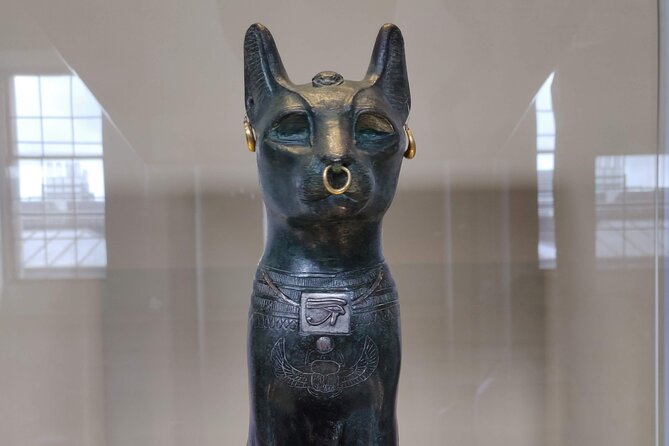
One of London’s biggest museums gets manageable fast. This British Museum tour runs with a qualified archaeologist guide and is built to help you move through the museum without getting stuck in information overload, especially when the museum holds eight million objects. I like that the route is designed to hit the most famous works while also pointing you to material most people skip.
Two stand-out parts for me are the clear focus on connections between objects and the civilizations behind them, and the way the tour tackles big-name highlights like Rosetta Stone and the Parthenon Marbles as more than just famous statues. One thing to consider: you’re packing a lot into under three hours, so if you want slow, wall-by-wall museum wandering, you might feel slightly rushed.
You’ll start at 10 Bernard St, meet up with the group, then head into the museum for a structured guided experience in English (max group size 25). It’s also a good option if you’re visiting solo, since the experience is designed for individual participation—not just couples and families. If you’re bringing a service animal, you’re welcome.
In This Review
- Key highlights worth planning around
- Why this British Museum tour feels different from a DIY visit
- The value of having an archaeologist steering the story
- Getting oriented: a route designed to prevent museum overwhelm
- Stop at the British Museum: what you’ll actually see and why it matters
- Ancient Egypt first: Rosetta Stone and Ramses II
- Assyria and Greece: power, empire, and the Parthenon Marbles
- Far-off worlds in the British Museum: Aztec crown jewels and Moai mysteries
- Viking and Anglo-Saxon Britain: Lewis Chessmen and Sutton Hoo
- How the pacing and group size help you learn (without burning your brain)
- Ticket value: you’re paying for the guidance, not just entry
- Service animals and solo-friendly participation
- Who should book this tour
- Should you book the British Museum archaeologist tour?
- FAQ
- How long is the British Museum tour?
- Is the tour in English?
- Where do I meet the guide?
- Where does the tour end?
- Is there a limit on group size?
- Is admission to the museum included?
- Do you allow service animals?
- Is the ticket mobile?
- What’s the cancellation policy?
- Is the tour suitable for most people?
Key highlights worth planning around
- Qualified archaeologist guide who can connect objects to civilizations and the larger unanswered questions
- A guided route that helps you cut through museum clutter instead of guessing where to go
- Famous anchors plus lesser-noticed stops, so you get the big names and context too
- Global coverage across Ancient Egypt, Assyria, Greece, the Aztec Empire, Easter Island, Viking-era finds, and more
- Small group size (up to 25), which makes it easier to stay together and hear explanations
More among the marbles and mummies
- London: British Museum Guided Tour
★ 4.3 · 1,182 reviews - British Museum London Guided Tour Semi-Private 8ppl Max
★ 5.0 · 984 reviews - London: British Museum Guided Tour with Entrance Tickets
★ 4.9 · 748 reviews - London: Tour of the British Museum
★ 4.1 · 678 reviews
Why this British Museum tour feels different from a DIY visit
The British Museum can be intense in the best and worst ways. Yes, it’s world-class. Also yes, it’s huge. With over eight million objects, the hardest part isn’t finding things—it’s choosing what to see first, and then making sense of what you’re looking at while you’re surrounded by artifacts from every corner of human time.
This tour solves that problem with a plan you can follow. You’re not wandering freely trying to make “museum priorities” work in your head. Instead, you get a guide who can group the collection into stories: who made the objects, why they mattered, and what we still can’t fully explain. That structure is especially helpful if your interests are broad—like ancient empires, art, writing, and archaeology—and you don’t want to pick only one theme.
I also like that the tour doesn’t just hand you a list of famous names. It’s framed as learning about ancient civilizations through artifacts, with the guide pointing out how archaeologists think and why some mysteries remain unresolved. That turns the museum from a photo-op factory into a place where you can actually reason through the past.
The value of having an archaeologist steering the story
A qualified archaeologist guide changes what you notice. Without expert context, it’s easy to see artifacts as isolated masterpieces—beautiful, historic, and done. With an archaeologist leading the way, you’re more likely to hear about how evidence is interpreted, what questions remain, and why certain discoveries can reshape our understanding.
In other words, you’re not just looking at objects—you’re practicing archaeology thinking in real time. That matters because so much of the British Museum is built around things that were found, traded, collected, studied, and reinterpreted over centuries. A trained guide can help you sort what’s known, what’s inferred, and what still isn’t nailed down.
This tour’s focus on mysteries is a big reason it works. You’ll hear about tantalizing gaps in our knowledge—without pretending those gaps are solved. It’s a more honest, and frankly more fun, way to tour than rushing to “facts only.”
Getting oriented: a route designed to prevent museum overwhelm
The tour starts at 10 Bernard St in London (WC1N 1LT) and finishes back at the British Museum area on Great Russell St (WC1B 3DG). That matters because it reduces the chance you’ll lose time on transit inside the neighborhood or waste energy figuring out where your group is.
From there, the goal is simple: get you to the highlights and then keep going. The museum is cluttered in the way only major museums can be—hundreds of rooms, lots of signage, and artifacts demanding attention at the same time. A guided route is what keeps you from spending your limited time staring at the map instead of the objects.
And with a maximum of 25 travelers, the pacing stays realistic. A smaller group is easier to manage for the guide, and it’s easier for you to stay close enough to hear explanations without constantly turning your head.
Still deciding? A handful more London outings we rated




Stop at the British Museum: what you’ll actually see and why it matters
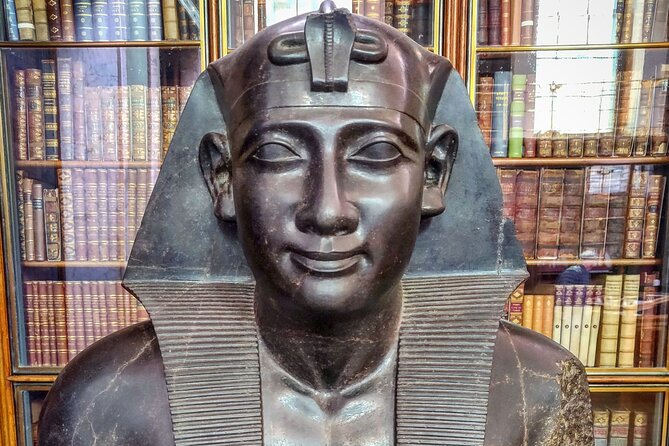
The tour is one continuous stop: the British Museum itself, for about 2 hours 45 minutes (approx.). That length is just long enough to cover several major civilizations and enough museums must-see anchors that you won’t leave feeling like you only skimmed.
You’ll start by spending time inside the museum’s most famous collection areas and then continue into less-obvious stops. The point isn’t to see everything. It’s to see the museum’s best “story arcs” in a way that makes the collection click.
Here’s how the experience tends to land, based on what the tour focuses on:
Ancient Egypt first: Rosetta Stone and Ramses II
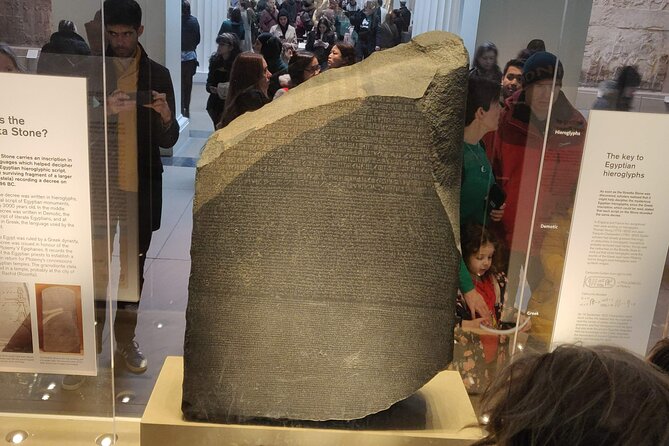
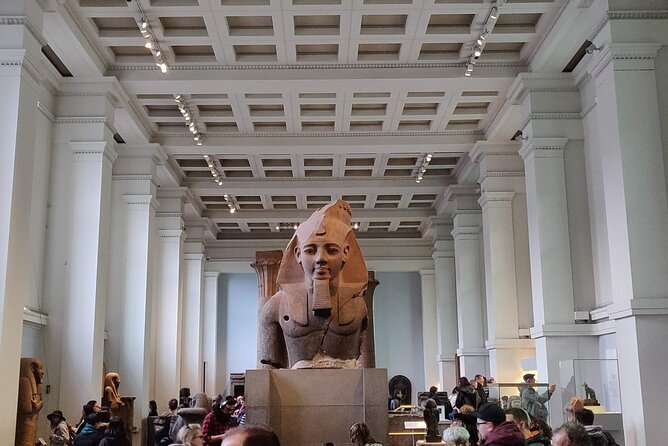
If you’ve heard of the British Museum before, chances are you’ve heard of Ancient Egypt. This tour builds that early momentum by covering major Egypt highlights, including the Rosetta Stone and the colossal statue associated with Pharaoh Ramses II.
Why start here? Because Egypt is one of the easiest entry points for most people. It’s also a civilization where objects can feel both deeply symbolic and incredibly specific—so it works well for learning “what you’re looking at” and “why it matters.”
What I like about this approach is that you’re not just ticking off famous pieces. You’re learning about the people behind them and the kinds of discoveries that let archaeologists connect objects to historical life. Egypt also gives the tour a strong foundation before it moves outward to other empires and artistic traditions.
Assyria and Greece: power, empire, and the Parthenon Marbles
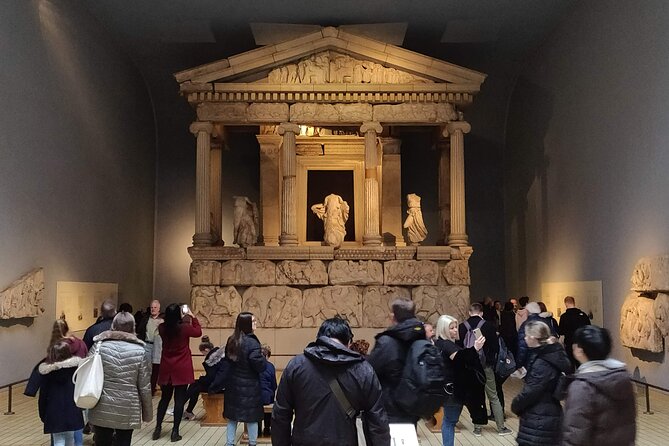
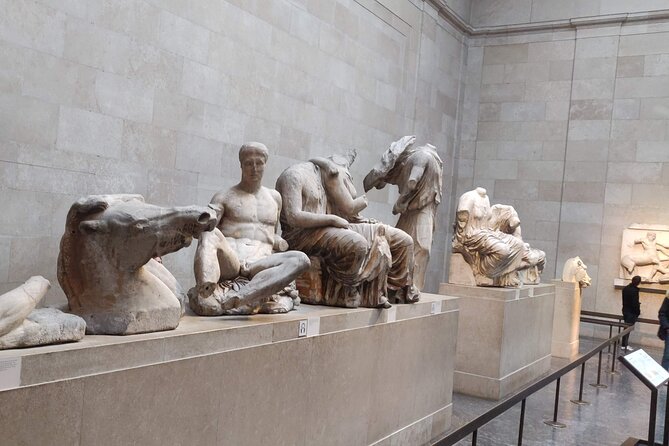
From Egypt, the tour’s focus shifts toward empires and world-shaping power, including key works from the Assyrian Empire and Greece. You’ll see the palaces associated with brutal rulers of the Assyrian Empire, then you’ll move into the Parthenon Marbles, tied to what’s described as the greatest Greek temples.
This section is valuable because it changes the tone. Egypt can feel like a long, continuous universe of symbols and monuments. Assyria and Greece introduce different themes—empire-building, public art, and how political messages can be carved in stone.
I also like the way this part keeps you thinking about context. When you’re viewing art and monumental pieces, it’s easy to admire the craft and stop there. With a guide framing the objects through civilization stories, the museum becomes more about ideas and less about random aesthetics.
Far-off worlds in the British Museum: Aztec crown jewels and Moai mysteries
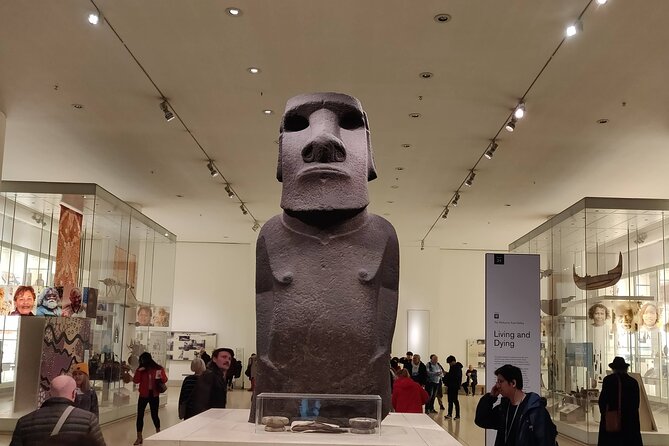
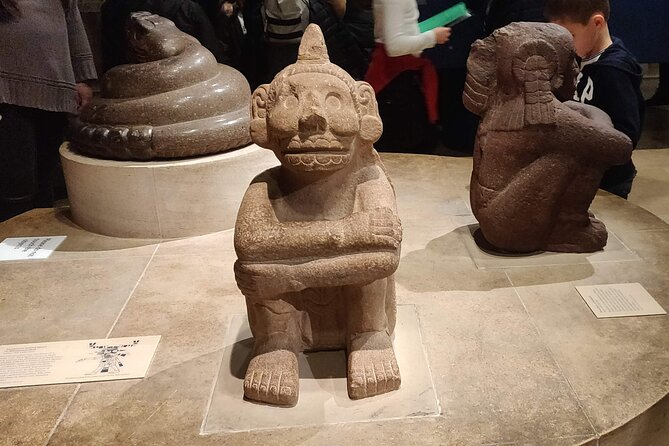
One of the more satisfying things about this tour is how it stretches your imagination beyond Europe and the Middle East. You’ll encounter the crown jewels of the Aztec Empire and you’ll also learn about the secrets of the Moai statues of Easter Island.
This is a smart pacing choice. After Egypt, Assyria, and Greece, your brain gets primed for “ancient empires.” Then the tour asks you to widen your lens and consider how cultures built identity, status, and meaning through objects—even when those objects come from places that feel worlds away.
You’re not just seeing famous items. You’re getting guided explanations that bring out the contrast between civilizations and the lingering mysteries archaeologists still face. That combination—recognizable highlights plus unresolved questions—is what keeps this kind of museum tour from turning into a checklist.
Viking and Anglo-Saxon Britain: Lewis Chessmen and Sutton Hoo
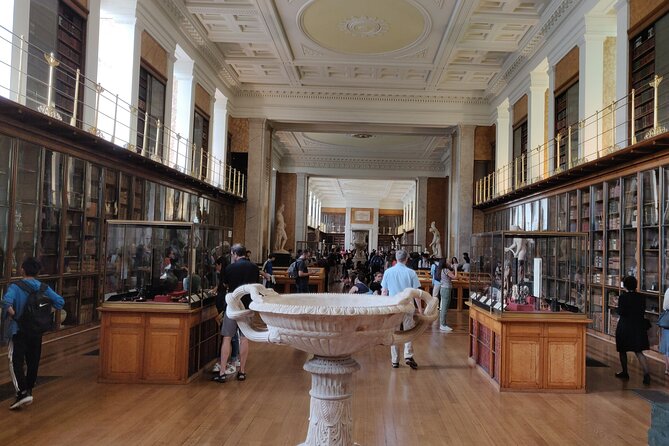
The tour finishes with a British and Northern Europe thread that’s especially rewarding if you like when history turns back toward home. You’ll cover the Lewis Chessmen, described as the most astounding relic to survive from the Viking age, and you’ll also see the Sutton Hoo hoard linked to the grave of the mysterious King Raedwald.
Why this segment works: it adds variety to the overall story. Up to this point, the museum tour has you traveling across ancient civilizations that many visitors may only know from names. Then you land on material tied closely to early medieval Britain and the kind of discovery that changes how people picture the past.
It’s also a great emotional payoff. Museums can feel distant. But finds connected to your region—especially those tied to legends and mystery—make the timeline feel less abstract. Even if you’re not a hardcore history person, this part is often the one that makes the tour feel personal.
How the pacing and group size help you learn (without burning your brain)
A tour like this has a simple trade-off: more coverage in less time. Here, the payoff is you get a structured route through key parts of the British Museum instead of trying to build your own.
A group size up to 25 also helps learning. The guide can keep you together, and you’re less likely to miss the explanations because you drift half a room away. If you’ve done museum tours where everyone spreads out, you know how frustrating it is to lose the thread. This format is built to prevent that.
English-only delivery is another practical detail. If English is your comfort zone, it keeps your attention on the artifacts and the archaeology conversation, not on translation.
Ticket value: you’re paying for the guidance, not just entry
The tour information notes that admission ticket is free. That’s a big value point, because it means your money goes toward expert guidance, not double-paying for museum entry.
In a place like the British Museum, where you could easily spend most of a day if you let yourself, guided time becomes the real product. You’re buying the ability to choose well, understand what you’re seeing, and connect the major highlights into a clearer story.
If you’re visiting London with limited time, this is the kind of arrangement that makes sense. You get a concentrated dose of the museum’s most famous artifacts plus the interpretive layer that makes them understandable.
Service animals and solo-friendly participation
If you’re traveling with a service animal, you’ll want to know you’re welcome. The tour also explicitly allows service animals, which removes a common point of uncertainty for people who need their animal with them.
For solo travelers, the best practical insight is this: the experience is designed so a solo attendee can still get accommodation within the group setting. With a max of 25, you’re not treated like an afterthought. The guide’s job is to keep you in the loop as you move.
That may sound like a small detail, but solo museum visits can be awkward when a tour is really built for couples and groups. This one is set up for real participation either way.
Who should book this tour
This British Museum tour fits best if you:
- Love ancient civilizations and want a guided way to connect artifacts to their cultures
- Prefer a smart route over spending hours picking your own highlights
- Want the museum’s big names plus a few less obvious stops
- Like archaeology thinking—especially how archaeologists handle mysteries and incomplete evidence
It might feel less ideal if you:
- Want a slow, unscripted walk through every wing
- Get restless when you’re following a structured path rather than free-roaming
Should you book the British Museum archaeologist tour?
Yes, if you want to leave feeling like you understood what you saw. The museum is so massive that DIY can turn into random wandering, even for people who love history. This tour gives you a plan, an archaeologist guide, and a route that covers major anchors like Rosetta Stone, Ramses II, Parthenon Marbles, Lewis Chessmen, and Sutton Hoo—with explanations meant to connect the dots.
Book it when your time in London is limited or when you want the best learning-per-hour version of the British Museum. If you have a full day and love drifting, you can do that too. But for a focused visit that actually teaches, this is one of the cleaner choices you can make.
FAQ
How long is the British Museum tour?
The tour runs for about 2 hours 45 minutes (approx.).
Is the tour in English?
Yes, it is offered in English.
Where do I meet the guide?
You start at 10 Bernard St, London WC1N 1LT, UK.
Where does the tour end?
The tour ends at The British Museum on Great Russell St, London WC1B 3DG, UK.
Is there a limit on group size?
Yes. The tour has a maximum of 25 travelers.
Is admission to the museum included?
The tour information indicates an admission ticket free arrangement.
Do you allow service animals?
Yes, service animals are allowed.
Is the ticket mobile?
Yes, the tour uses a mobile ticket.
What’s the cancellation policy?
You can cancel for a full refund if you cancel up to 24 hours in advance. If you cancel less than 24 hours before the start time, the amount paid is not refunded.
Is the tour suitable for most people?
The tour notes that most travelers can participate.
More Tours in London
- From London: Harry Potter Warner Bros Studio Tour
★ 4.7 · 26,588 reviews - Magical London: Harry Potter Guided Walking Tour
★ 4.7 · 22,044 reviews - London: Warner Bros. Studio Harry Potter Tour & Branded Bus
★ 4.7 · 19,194 reviews - London Big Bus Hop-On Hop-Off Tour with Optional River Cruise
★ 3.5 · 10,803 reviews - London Small Group Tour of Historical Pubs
★ 5.0 · 10,422 reviews
More Tour Reviews in London
- From London: Harry Potter Warner Bros Studio Tour
★ 4.7 · 26,588 reviews - London: Westminster to Greenwich River Thames Cruise
★ 4.5 · 22,836 reviews - Magical London: Harry Potter Guided Walking Tour
★ 4.7 · 22,044 reviews - London: Madame Tussauds London
★ 4.6 · 20,915 reviews - London: Warner Bros. Studio Harry Potter Tour & Branded Bus
★ 4.7 · 19,194 reviews
The British Museum, Continued
- London: British Museum Guided Tour
★ 4.3 · 1,182 reviews - British Museum London Guided Tour Semi-Private 8ppl Max
★ 5.0 · 984 reviews - London: British Museum Guided Tour with Entrance Tickets
★ 4.9 · 748 reviews - London: Tour of the British Museum
★ 4.1 · 678 reviews - London: British Museum Audio Tour & Priority Entrance Ticket
★ 4.5 · 631 reviews
Just reviewed around London





British Museum Tours, compared.
 ★ 4.3British Museum Guided TourFrom $231,182 reviews
 ★ 5.0British Museum London Guided Tour Semi-Private 8ppl MaxFrom $108984 reviews
 ★ 4.9British Museum Guided Tour with Entrance TicketsFrom $39748 reviews
 ★ 4.1Tour of the British MuseumFrom $14678 reviews
 ★ 4.5British Museum Audio Tour & Priority Entrance TicketFrom $9631 reviews
 ★ 5.0The British Museum London – Exclusive Guided Museum TourFrom $108555 reviews
 ★ 4.2Afternoon Tea at the British MuseumFrom $58511 reviews
 ★ 4.0British Museum Guided TourFrom $18470 reviews
Browse the lists this tour appears in