
Reviewed · LONDON
The women of London
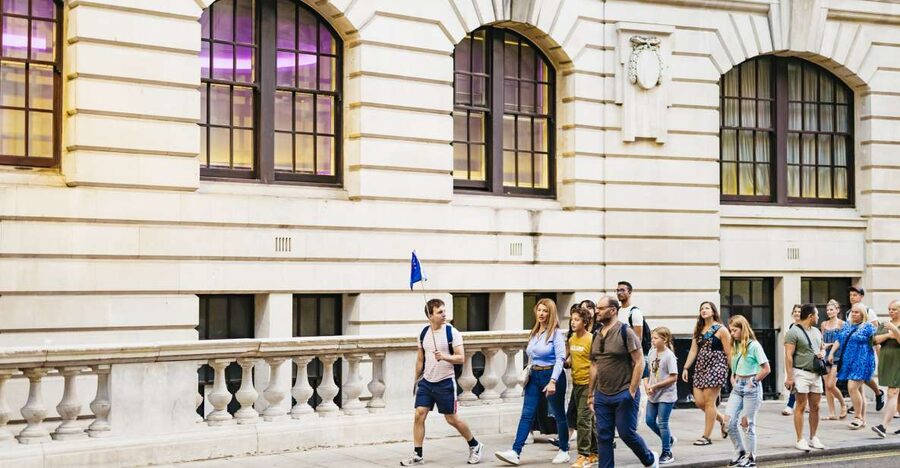
London’s feminist trail starts fast. In about 2.5 hours, you’ll walk past major landmarks and get a guided look at the women who shaped the city’s history, with lots of time to ask questions. I especially like that it’s a small group of no more than 10 people, so the stops don’t feel rushed, and that the focus stays on real places tied to women’s roles in public life.
One possible catch: the Buckingham Palace stop says admission ticket not included. That means you can still enjoy the area and hear the story around it, but if you want to go inside, you’ll need to plan for an extra ticket.
The tour is offered with a guide in Spanish or French, and it runs on a simple, mobile-ticket setup. The route is mostly outdoors, and it ends at Agatha Christie’s memorial, which is a satisfying final note if you like your London history with a little drama and wit—very much the kind of storytelling people rave about when Carmen is guiding.
In This Review
- Key highlights to look for
- Why this “women of London” walk works so well in 2.5 hours
- Where the walk starts (and why the meeting point matters)
- Buckingham Palace and The Mall: hearing the story at the palace gate
- Crimean War Memorial: Florence Nightingale in 10 minutes
- Parliament Square and Millicent Garrett Fawcett: where activism meets the center of power
- Emmeline Pankhurst Memorial: WSPU and the energy of organized resistance
- Downing Street area and the Women of World War II Memorial: fast stop, strong connection
- Trafalgar Square: WWI and votes for women in a public, high-energy setting
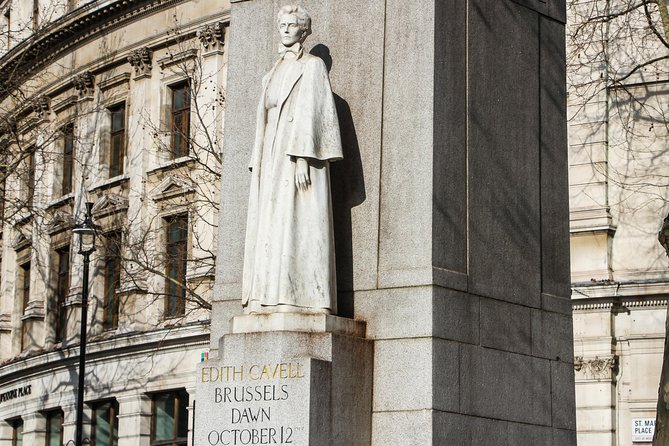
- Edith Cavell Memorial: a brief pause with a personal story focus
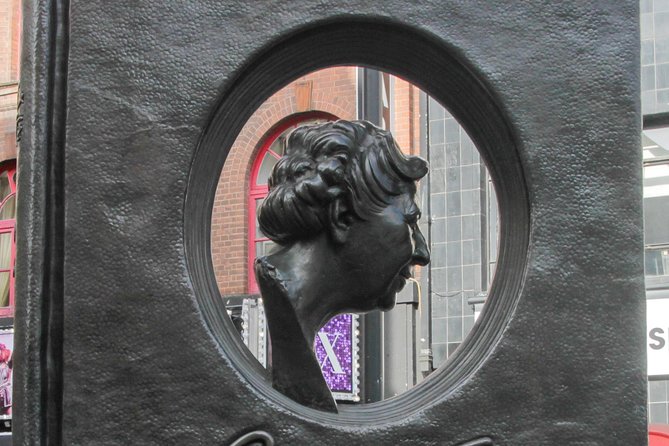
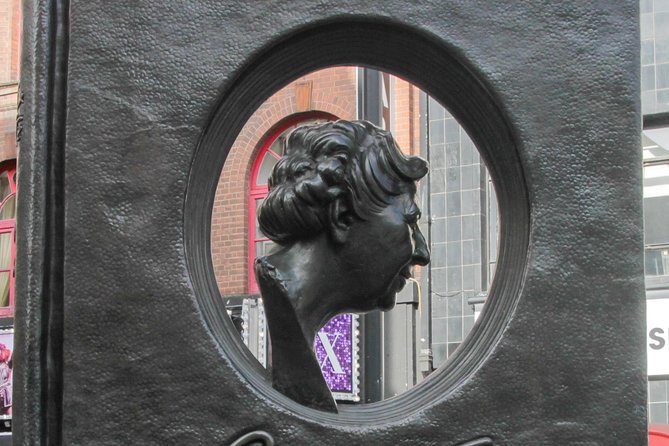
- Agatha Christie Memorial: ending with London’s storyteller energy
- Price and value: what $20.53 buys you in central London
- The guide makes or breaks this kind of tour (and Carmen is a big reason)
- Pace, Q&A time, and what the 2.5-hour format means for you
- What to expect at each stop, in plain terms
- Who should book this tour, and who might want something else
- FAQ
- FAQ
- Is the women of London tour available in Spanish or French?
- How long is the tour?
- How big is the group?
- Is admission included for Buckingham Palace?
- Where does the tour start and end?
- Can I cancel for a full refund?
- Quick verdict: Should you book?
Key highlights to look for
- A small group (max 10) keeps the Q&A from turning into a lecture
- Spanish or French guide included, so you get more than a self-guided route
- Major landmarks connected to women instead of the usual male-only highlights
- Only one paid-entry stop is flagged (Buckingham Palace); the rest are free to visit
- Repeated praise for Carmen’s style: friendly, detailed, and genuinely invested
Not sure yet? See how a few of London's most-booked trips stack up:
- From London: Harry Potter Warner Bros Studio Tour
★ 4.7 · 26,588 reviews - London: Westminster to Greenwich River Thames Cruise
★ 4.5 · 22,836 reviews - Magical London: Harry Potter Guided Walking Tour
★ 4.7 · 22,044 reviews - London: Madame Tussauds London
★ 4.6 · 20,915 reviews
Why this “women of London” walk works so well in 2.5 hours
London can be overwhelming at first—streets, statues, squares, and a lot of history that quietly defaults to men. This tour takes that same dense, central London layout and uses it like a classroom. You’re not just ticking off famous buildings. You’re learning why certain women mattered, and how they show up in the city’s most visible public spaces.
The small-group format is a big part of why it feels good. With up to 10 people, you’re more likely to get answers to the questions that come up while you’re standing right in front of the monument. It also makes the pacing feel humane. You’re not sprinting between stops with strangers who are already checked out.
Another thing I like: the tour doesn’t treat feminist history as a side topic. It’s the spine of the walk. You’ll connect the women linked to activism, war, and public life to places you probably already recognize—Buckingham Palace, Parliament Square, Trafalgar Square—and that makes the information stick.
Where the walk starts (and why the meeting point matters)
You start at the Constance Fund fountain of DianaLondon SW1A 1RD, with the tour set to begin at 2:00 pm. Starting from a well-known public point helps you arrive without stress, especially in central London where “nearby” can still mean a long stumble.
You end at the Agatha Christie memorial on Cranbourn St, London WC2H 7AB. Ending there is smart. It gives the tour a modern pop-cultural landing pad, instead of stopping somewhere that feels purely ceremonial. If you’re planning dinner after, that end point helps you keep the evening moving.
Also, the tour uses a mobile ticket system. That’s useful in London, where paper tickets are easy to misplace and smartphone tickets save time at the start.
Buckingham Palace and The Mall: hearing the story at the palace gate
The first stop is Buckingham Palace, with about 15 minutes on The Mall and a focus framed as Her Majesty the Queen. Admission isn’t included here, but the payoff is what your guide does with the location. You’re standing near an iconic symbol of British public life, and you’ll hear how women’s influence shows up in that space.
Here’s the practical point: 15 minutes is not long enough to do a full palace visit even if you had your own ticket plans. So think of this stop as the moment you set the tone—how the tour will connect women’s roles to the most visible parts of central London.
If you want to go inside the palace during your day, treat this tour stop as the preface, not the main act. Plan separate entry time so you don’t feel rushed. If you’re happy viewing the palace area from outside, you’ll still get value from the guided context.

Crimean War Memorial: Florence Nightingale in 10 minutes
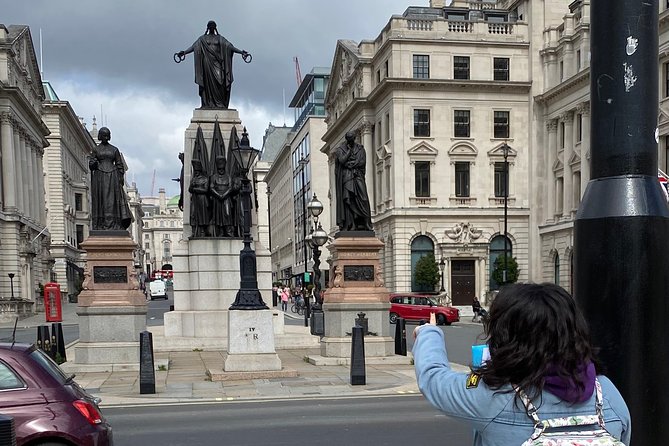
Next up is the Crimean War Memorial, with Florence Nightingale highlighted as the featured figure. This is one of those stops where the guide’s narration is the main event. The memorial setting gives you the “why” behind the name, and it ties Nightingale’s significance to the broader story of women and public impact during wartime.
The time here is short—around 10 minutes—so don’t expect a slow, museum-like pace. Instead, use it as a quick foundation. If you’ve ever wondered how one person’s work becomes a public symbol, this stop is designed to answer that in a compact format.
One good thing about this stop: it’s free to attend. You’re spending time and listening energy, not money.
Parliament Square and Millicent Garrett Fawcett: where activism meets the center of power
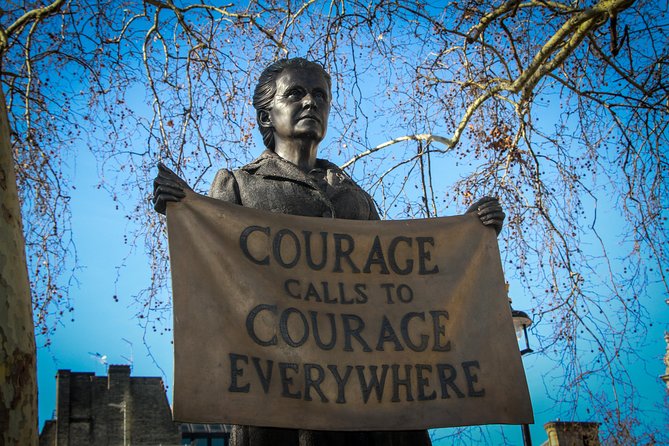
Parliament Square takes about 20 minutes, and the focus is Millicent Garrett Fawcett and Black Friday. That combination is exactly why this tour works. Parliament Square is already a stage for politics, protest, and public debate. Your guide connects that backdrop to the people and moments tied to women’s struggle for political voice.
This is also a stop where you’ll benefit from asking questions. The square is visually open, so it’s easy for a guide to point out the logic of the story: where activism happened, how it was seen, and why it mattered in the public eye.
Potential drawback? Parliament Square can be busy, and on busy sidewalks the conversation sometimes has to rise above the city noise. Still, with a group capped at 10, you’re more likely to hear clearly than you would on a larger walking tour.
Emmeline Pankhurst Memorial: WSPU and the energy of organized resistance
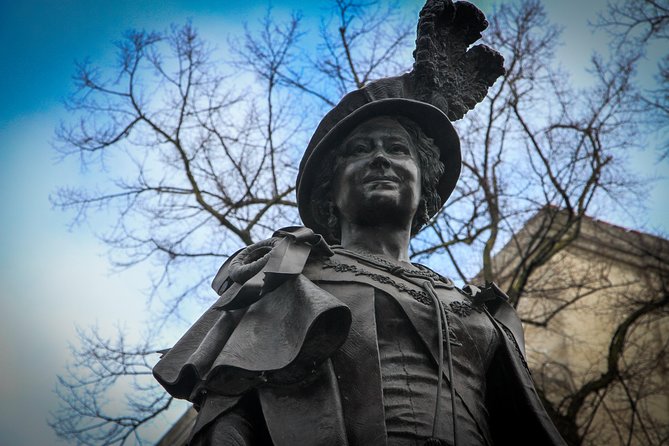
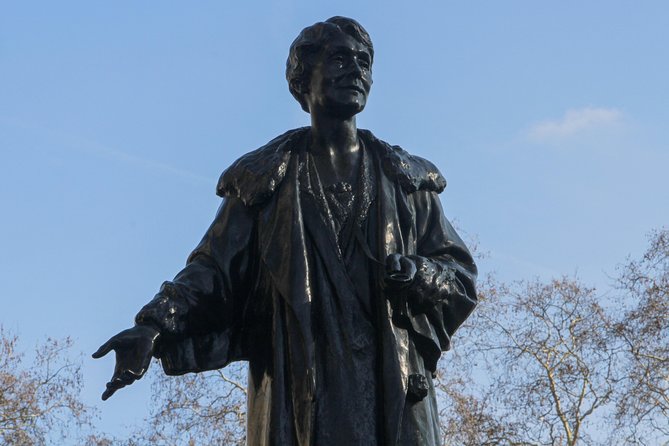
The Emmeline Pankhurst Memorial is next, with about 15 minutes and a focus on Emmeline Pankhurst and the WSPU. If you’re new to suffrage history, this stop is the place to ask for grounding: how the WSPU era fits into the larger push for women’s rights.
This is also where I’d expect you to feel the guide’s personality. Carmen, in particular, has been praised for bringing the suffragettes to life—she’s not just reciting names. People describe her as friendly, deeply informed, and very invested in the story.
As with the other central stops, admission is free here. That means you get the learning without a ticket hurdle. The stop is timed well too. You’re given enough minutes to absorb the point and still move forward.
Downing Street area and the Women of World War II Memorial: fast stop, strong connection
Then it’s the Women of World War II Memorial, including a link to Downing Street and the suffragettes, with only about 5 minutes. This is the kind of stop that could feel too quick on paper. In practice, it can work because your guide is stitching themes together.
What I like about this brief segment is the contrast. You’re shifting from the earlier suffrage fight into a wartime era of women’s roles, then back to the political symbolism around Downing Street. Even in a few minutes, it encourages you to think about women’s impact as ongoing, not limited to one movement or one decade.
If you like to take photos, consider doing it quickly and then spending your attention on listening. With this short stop, the narration matters more than the shot.
Trafalgar Square: WWI and votes for women in a public, high-energy setting
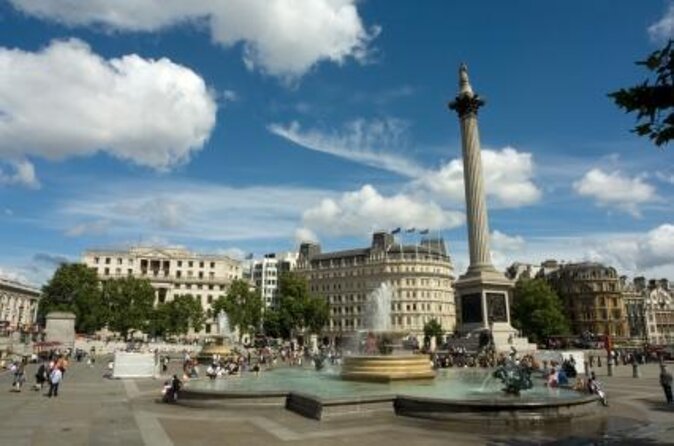
Trafalgar Square gets around 10 minutes, focusing on WWI and votes for women. This is a powerful pairing because Trafalgar Square is one of London’s most recognizable public squares, the kind of place where people naturally look up, pause, and take in the scene. Your guide turns that “pause moment” into historical meaning.
This stop is also free, and the layout of Trafalgar Square makes it easy to get oriented. If you’re tired of wandering and want a landmark that feels like an anchor, this is it.
One practical note: London weather can change fast around open squares. If you’re going in cooler months, a light layer helps, because you’ll be standing and walking between stops rather than ducking into indoor spaces.
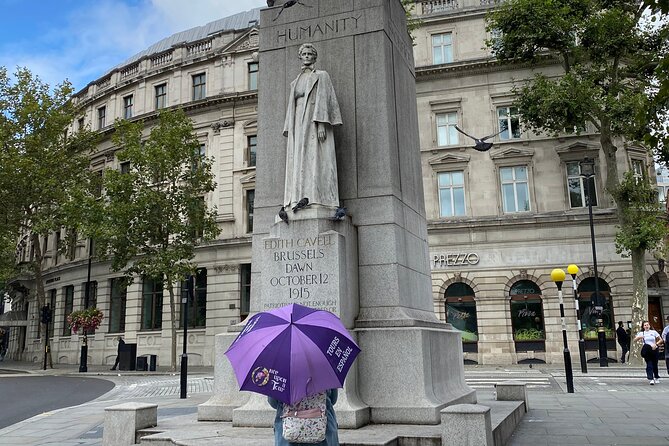
Edith Cavell Memorial: a brief pause with a personal story focus
The Edith Cavell Memorial stop is only about 5 minutes, focused on the life of Edith Cavell. Short stops can be underwhelming on tours that feel like checklists. Here, the point is likely to give you a quick, focused moment tied to a named figure—then keep the route moving.
If you’re the type who reads every plaque slowly, you might wish you had more time. But the structure works for most people: it adds emotional weight without turning the tour into an all-day memorial crawl.
And again, it’s free. So you’re spending your time, not your budget.
Agatha Christie Memorial: ending with London’s storyteller energy
You finish at the Agatha Christie Memorial with about 10 minutes. If the earlier stops have been emotionally and politically heavy, this ending is a smart tonal shift. It gives your last moments a different kind of London fame—someone who shaped the cultural side of the city.
Ending here also makes the tour feel complete. You started with the most formal, government-associated symbol you could imagine. You end with a writer tied to London’s imagination. That arc makes it easier to remember what you learned, because it’s not all one theme.
If you enjoy literature, use the extra minutes to ask your guide how Christie’s London fits with the broader women’s story you’ve been hearing. Even a short, practical answer can make the ending land harder.
Price and value: what $20.53 buys you in central London
The price is $20.53 per person, and for that you get a guided walk in Spanish or French, plus a route packed with major public landmarks. Here’s the value logic I’d use as you decide:
- The tour includes a guide. In London, that’s where the real cost lies on most guided experiences.
- The stop list shows most admissions as free, which matters. Only the Buckingham Palace stop is marked admission ticket not included.
- You get time built into each location (from about 5 minutes to 20 minutes), which helps you actually process the story instead of just walking through scenery.
In other words, you’re paying primarily for interpretation and guided pacing—not for paying your way into a stack of paid sites.
So if you’re trying to do a lot of central London with minimal additional spending, this is a strong fit. If you already plan to visit a palace interior separately anyway, this tour becomes even better as the “meaning and context” layer to your day.
The guide makes or breaks this kind of tour (and Carmen is a big reason)
This tour leans hard on storytelling. You’re not watching a video. You’re standing in front of named places and hearing how they connect to specific women and specific moments.
That’s why the guide matters. The Spanish-language experience is often praised for Carmen’s approach: detailed knowledge about the suffragettes, a friendly manner, and that sense of caring that makes history feel like a lived argument rather than a list of dates. People also note how easy it is to enjoy the tour when the guide is both warm and well-prepared.
When a tour is built around feminist history, a good guide also helps you keep context straight: what each monument represents and why that location gets included in a walking route. If you’ve ever done self-guided monument hopping, you know how easy it is to miss the point.
Pace, Q&A time, and what the 2.5-hour format means for you
The tour runs for about 2 hours 30 minutes. That length is long enough to build momentum, but short enough that you’ll likely still feel fresh for the rest of your day.
A big promise here is that you’ll have plenty of time to ask questions. In practical terms, that usually means the guide isn’t just rushing through talking points. With a small group of up to 10, you get more chances to clarify what you’re hearing—especially if you’re learning names like Millicent Garrett Fawcett or Emmeline Pankhurst for the first time.
If you like tours where you can react in real time—where your curiosity can steer the conversation—this format is a good match.
What to expect at each stop, in plain terms
Here’s how I’d mentally plan the day based on the structure:
- You’ll start at the Diana fountain area and move into the classic landmark zone.
- You’ll have a mix of longer stops (like Parliament Square at about 20 minutes) and quick ones (like 5-minute memorial stops).
- Every location is tied to a person or theme: Florence Nightingale, Millicent Garrett Fawcett and Black Friday, Emmeline Pankhurst and the WSPU, women’s roles around World War II and suffragettes, WWI and votes for women, Edith Cavell, and Agatha Christie.
If you prefer tours with mostly indoor time, this one may feel a bit more “stand and listen” than you’d like. But if you don’t mind that, you’ll get more meaning per minute because you’re hearing the story as you look at the setting.
Who should book this tour, and who might want something else
This is a great pick if you:
- Want feminist history tied to real London landmarks
- Prefer a small-group walking format over large groups
- Like asking questions and getting answers on the spot
- Enjoy women’s influence across politics, war, and culture (not just one theme)
You might want a different option if:
- You’re mainly interested in indoor museum time
- You’re set on entering Buckingham Palace during this exact stop (admission isn’t included)
- You’re not comfortable walking between central London points for a couple hours
FAQ
FAQ
Is the women of London tour available in Spanish or French?
Yes. The tour guide is available for Spanish or French.
How long is the tour?
The duration is approximately 2 hours 30 minutes.
How big is the group?
The tour has a maximum of 10 travelers/participants.
Is admission included for Buckingham Palace?
No. The Buckingham Palace stop lists admission ticket not included. The other stops are marked as free.
Where does the tour start and end?
It starts at the Constance Fund fountain of DianaLondon SW1A 1RD and ends at the Agatha Christie memorial, Cranbourn St, London WC2H 7AB.
Can I cancel for a full refund?
Yes. You can cancel up to 24 hours in advance for a full refund.
Quick verdict: Should you book?
Yes, I’d book it if you want a focused, women-first London experience that uses the city’s most famous spaces as teaching tools. The pricing is low enough that you’re not budgeting for a pile of tickets, and the small group size plus Q&A time is where the value really shows. If you’re especially curious about suffragettes and want a guide who brings the story to life, this is one of the better ways to spend a 2.5-hour window in central London.
More Tour Reviews in London
- From London: Harry Potter Warner Bros Studio Tour
★ 4.7 · 26,588 reviews - London: Westminster to Greenwich River Thames Cruise
★ 4.5 · 22,836 reviews - Magical London: Harry Potter Guided Walking Tour
★ 4.7 · 22,044 reviews - London: Madame Tussauds London
★ 4.6 · 20,915 reviews - London: Warner Bros. Studio Harry Potter Tour & Branded Bus
★ 4.7 · 19,194 reviews




